Ch. 17 - Carbonyl Addition Reactions: Aldehydes and Ketones
Mullins - Organic Chemistry: A Learner Centered Approach 1st Edition
Mullins1st EditionOrganic Chemistry: A Learner Centered ApproachISBN: 9780137566471당신이 사용하는 게 아니라요?교과서 변경
16장, 문제 23a

For each of the following carbonyl addition reactions, would you expect a racemic mixture or a mixture enriched in one stereoisomer? In each case, draw both possible stereoisomeric products.
(a) Chemical reaction diagram showing carbonyl compound reacting with MgBr and H2O, producing an alcohol with stereoisomers.

검증된 단계별 안내
1
Identify the type of reaction: The image shows a Grignard reaction, where a Grignard reagent (ethyl magnesium bromide) is added to a ketone (butanone) followed by an acid quench.
Understand the mechanism: The Grignard reagent acts as a nucleophile, attacking the electrophilic carbonyl carbon of the ketone, forming a tetrahedral intermediate.
Consider stereochemistry: The attack of the Grignard reagent on the planar carbonyl group can occur from either side, leading to the formation of two possible stereoisomers.
Draw the products: The reaction will produce two stereoisomers, which are enantiomers. Draw both possible configurations of the newly formed chiral center.
Determine the mixture type: Since the attack can occur from either side with equal probability, a racemic mixture of the two enantiomers is expected.

비슷한 문제에 대한 검증된 영상 답변:

이 영상 해법은 위 문제에 도움이 된다고 튜터들이 추천한 것입니다.

주요 개념

질문에 올바르게 답하기 위해 반드시 이해해야 하는 핵심 개념들은 다음과 같습니다.

Carbonyl Chemistry

Carbonyl compounds, characterized by a carbon-oxygen double bond (C=O), are key functional groups in organic chemistry. They can undergo various reactions, including nucleophilic addition, where a nucleophile attacks the electrophilic carbon atom. Understanding the reactivity and properties of carbonyls is essential for predicting the outcomes of addition reactions.
추천 영상:
04:20
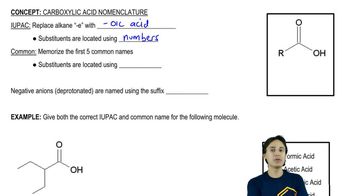
Carboxylic Acids Nomenclature

Stereochemistry

Stereochemistry involves the study of the spatial arrangement of atoms in molecules and how this affects their chemical behavior. In carbonyl addition reactions, the formation of chiral centers can lead to the creation of stereoisomers. Recognizing whether a reaction produces a racemic mixture or isomerically enriched products is crucial for understanding the stereochemical outcome.
추천 영상:
가이드 코스
1:38
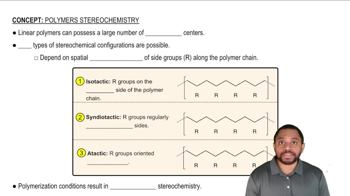
Polymer Stereochemistry Concept 1

Nucleophilic Addition Mechanism

The nucleophilic addition mechanism describes how a nucleophile attacks the electrophilic carbon of a carbonyl compound, leading to the formation of an alkoxide intermediate. Depending on the symmetry of the carbonyl and the nature of the nucleophile, this process can yield either a racemic mixture of products or a predominant stereoisomer. Analyzing the mechanism helps predict the stereochemical results of the reaction.
추천 영상:
08:27
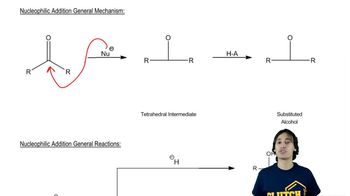
Nucleophilic Addition