Ch. 17 - Carbonyl Addition Reactions: Aldehydes and Ketones
Mullins - Organic Chemistry: A Learner Centered Approach 1st Edition
Mullins1st EditionOrganic Chemistry: A Learner Centered ApproachISBN: 9780137566471당신이 사용하는 게 아니라요?교과서 변경
16장, 문제 22a

Suggest a carbonyl to react with NaCN/HCN to produce the following cyanohydrins.
(a) Reaction scheme showing NaCN and HCN converting a carbonyl compound into a cyanohydrin with hydroxyl and cyano groups.

검증된 단계별 안내
1
Step 1: Understand the reaction mechanism. The reaction between a carbonyl compound and NaCN/HCN involves the nucleophilic addition of the cyanide ion (CN⁻) to the carbonyl carbon, forming a cyanohydrin.
Step 2: Identify the structure of the cyanohydrin product. Analyze the given image to determine the structure of the cyanohydrin, focusing on the functional groups and the carbon skeleton.
Step 3: Determine the carbonyl precursor. Since cyanohydrins are formed by the addition of CN⁻ to the carbonyl carbon, the carbonyl compound should have the same carbon skeleton as the cyanohydrin minus the CN group.
Step 4: Consider the stereochemistry. If the cyanohydrin has chiral centers, consider the stereochemistry of the starting carbonyl compound, as it can influence the stereochemistry of the product.
Step 5: Suggest the carbonyl compound. Based on the analysis, suggest a carbonyl compound (either an aldehyde or ketone) that would react with NaCN/HCN to yield the cyanohydrin with the desired structure.

비슷한 문제에 대한 검증된 영상 답변:

이 영상 해법은 위 문제에 도움이 된다고 튜터들이 추천한 것입니다.
영상 길이:
2m

주요 개념

질문에 올바르게 답하기 위해 반드시 이해해야 하는 핵심 개념들은 다음과 같습니다.

Carbonyl Compounds

Carbonyl compounds, characterized by the presence of a carbon-oxygen double bond (C=O), include aldehydes and ketones. They are highly reactive due to the electrophilic nature of the carbon atom, making them susceptible to nucleophilic attack. Understanding the structure and reactivity of carbonyls is essential for predicting their behavior in reactions, such as those with nucleophiles like cyanide.
추천 영상:
01:40
Defining meso compounds.

Nucleophilic Addition

Nucleophilic addition is a fundamental reaction mechanism in organic chemistry where a nucleophile attacks an electrophilic carbon atom, leading to the formation of a new bond. In the case of carbonyl compounds, nucleophiles such as NaCN or HCN can add to the carbonyl carbon, resulting in the formation of cyanohydrins. This mechanism is crucial for understanding how to synthesize various organic compounds from carbonyl precursors.
추천 영상:
08:27
Nucleophilic Addition

Cyanohydrins

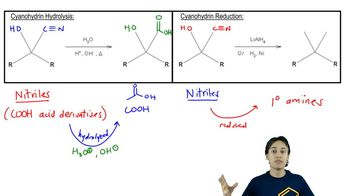
Cyanohydrins are organic compounds formed by the addition of hydrogen cyanide (HCN) to carbonyl compounds, resulting in a hydroxyl group (-OH) and a cyano group (-CN) attached to the same carbon atom. They are important intermediates in organic synthesis and can be further transformed into various functional groups. Recognizing the structure and properties of cyanohydrins is vital for predicting their reactivity and potential applications in organic chemistry.
추천 영상:
02:36
Nitrile Reduction