Ch. 18 - Nucleophilic Acyl Substitution 1: Carboxylic Acids
Mullins - Organic Chemistry: A Learner Centered Approach 1st Edition
Mullins1st EditionOrganic Chemistry: A Learner Centered ApproachISBN: 9780137566471당신이 사용하는 게 아니라요?교과서 변경
17장, 문제 5a

Calculate the oxidation numbers for the indicated atoms.
a. Chemical structure of a benzene ring with an arrow pointing to H2CrO4, indicating a reaction involving oxidation.

검증된 단계별 안내
1
Identify the structure of the starting material. The image shows a benzene ring with a side chain, which is likely a primary alcohol or an aldehyde, given the context of oxidation reactions.
Recognize the oxidizing agent. In this case, H₂CrO₄ (chromic acid) is a strong oxidizing agent commonly used to oxidize primary alcohols to carboxylic acids and secondary alcohols to ketones.
Determine the oxidation state of the carbon atom in the side chain before the reaction. If the side chain is a primary alcohol (R-CH₂OH), the carbon attached to the OH group is in the -1 oxidation state.
Predict the product of the reaction. H₂CrO₄ will oxidize the primary alcohol to a carboxylic acid (R-COOH), changing the oxidation state of the carbon from -1 to +3.
Calculate the change in oxidation number for the carbon atom. The change from -1 to +3 indicates an increase in oxidation state, confirming that oxidation has occurred.

비슷한 문제에 대한 검증된 영상 답변:

이 영상 해법은 위 문제에 도움이 된다고 튜터들이 추천한 것입니다.

주요 개념

질문에 올바르게 답하기 위해 반드시 이해해야 하는 핵심 개념들은 다음과 같습니다.

Oxidation Numbers

Oxidation numbers are a way to keep track of electrons in atoms as they undergo chemical reactions. They represent the hypothetical charge an atom would have if all bonds were ionic. In organic chemistry, oxidation numbers help determine how electrons are transferred in reactions, especially in redox processes. For example, in the reaction with H2CrO4, identifying the oxidation state of carbon atoms in the benzene ring is crucial.
추천 영상:
03:40
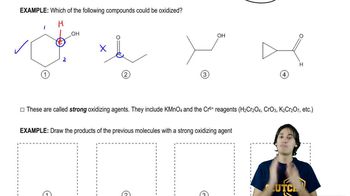
Strong oxidizing agents

Chromic Acid (H2CrO4) as an Oxidizing Agent

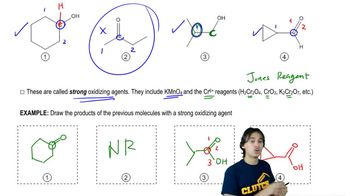
Chromic acid (H2CrO4) is a strong oxidizing agent commonly used in organic chemistry to oxidize alcohols to ketones or carboxylic acids. It works by increasing the oxidation state of carbon atoms, typically converting primary alcohols to carboxylic acids and secondary alcohols to ketones. Understanding its role in the reaction helps predict the changes in oxidation numbers of the involved atoms.
추천 영상:
05:53
Strong oxidizing agents

Benzene Ring Structure

The benzene ring is a stable, aromatic hydrocarbon with a hexagonal structure and alternating double bonds. Its stability is due to resonance, where electrons are delocalized over the ring. In reactions, the benzene ring can influence the reactivity of attached groups, such as the side chain in the given structure. Recognizing the benzene ring's properties is essential for understanding how it affects the oxidation process in the reaction.
추천 영상:
09:04
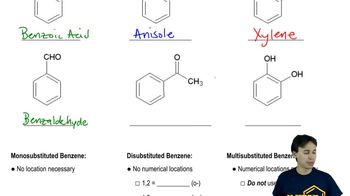
Benzene Nomenclature