Ch. 18 - Nucleophilic Acyl Substitution 1: Carboxylic Acids
Mullins - Organic Chemistry: A Learner Centered Approach 1st Edition
Mullins1st EditionOrganic Chemistry: A Learner Centered ApproachISBN: 9780137566471당신이 사용하는 게 아니라요?교과서 변경
17장, 문제 3a

Would you expect ∆S to be greater than, less than, or equal to zero in the following reactions?
a. Chemical reaction diagram illustrating reactants and products for entropy analysis.

검증된 단계별 안내
1
Step 1: Analyze the reaction. The reactants are acetate ion (CH3COO⁻) and ethyl bromide (CH3CH2Br). The products are ethyl acetate (CH3COOCH2CH3) and bromide ion (Br⁻). This is a nucleophilic substitution reaction.
Step 2: Consider the number of molecules involved. In the reactants, there are two separate molecules (CH3COO⁻ and CH3CH2Br). In the products, there are also two separate molecules (CH3COOCH2CH3 and Br⁻). Therefore, the number of molecules remains the same.
Step 3: Evaluate the change in molecular complexity. The reactants include a simple ion and a small organic molecule. The products include a slightly more complex organic molecule (ethyl acetate) and a simple ion (Br⁻). The molecular complexity increases slightly due to the formation of ethyl acetate.
Step 4: Consider the entropy (∆S). Entropy is a measure of disorder. Since the number of molecules remains constant and the molecular complexity increases slightly, the entropy change (∆S) is likely to be slightly negative or less than zero.
Step 5: Conclude the reasoning. Based on the analysis, ∆S is expected to be less than zero because the reaction results in a slight decrease in disorder due to the formation of a more complex molecule.

비슷한 문제에 대한 검증된 영상 답변:

이 영상 해법은 위 문제에 도움이 된다고 튜터들이 추천한 것입니다.

주요 개념

질문에 올바르게 답하기 위해 반드시 이해해야 하는 핵심 개념들은 다음과 같습니다.

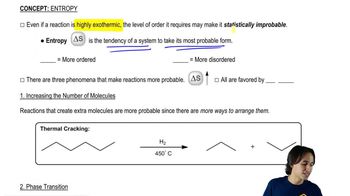
Entropy (∆S)

Entropy, denoted as ∆S, is a measure of the disorder or randomness in a system. In chemical reactions, an increase in the number of gas molecules or a transition from a more ordered state (like solid or liquid) to a less ordered state (like gas) typically results in a positive ∆S. Conversely, reactions that lead to a more ordered state usually have a negative ∆S.
추천 영상:
02:46
Explaining what entropy is.

Reaction Mechanism

The reaction mechanism describes the step-by-step process by which reactants are converted into products. Understanding the mechanism helps predict the changes in molecular structure and the resulting entropy changes. In the provided reaction, the formation of new bonds and the rearrangement of atoms can influence the overall disorder of the system.
추천 영상:
02:16
Heck Reaction Mechanism

Molecular Complexity

Molecular complexity refers to the number of atoms and the types of bonds in a molecule. Generally, as molecular complexity increases, the entropy of the system also increases due to the greater number of possible arrangements of atoms. In the given reaction, the products may have different complexities compared to the reactants, affecting the overall entropy change.
추천 영상:
05:02
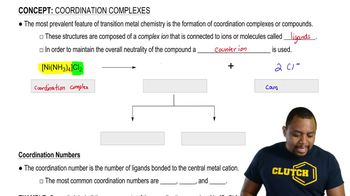
Coordination Complexes