Ch. 20 - Enolates: Carbonyl Addition and Substitution
Mullins - Organic Chemistry: A Learner Centered Approach 1st Edition
Mullins1st EditionOrganic Chemistry: A Learner Centered ApproachISBN: 9780137566471당신이 사용하는 게 아니라요?교과서 변경
19장, 문제 1

Beginning with acetylene and benzyl bromide and using any other inorganic reagents, propose a synthesis of the alkene shown here.
Chemical reaction diagram showing the synthesis of an alkene from benzyl bromide and acetylene.

검증된 단계별 안내
1
Step 1: Begin by deprotonating acetylene (C₂H₂) using a strong base such as sodium amide (NaNH₂). This will generate the acetylide anion (C≡C⁻), which is a nucleophile.
Step 2: Perform an SN2 reaction between the acetylide anion and benzyl bromide (C₆H₅CH₂Br). The acetylide anion will attack the benzyl bromide, displacing the bromide ion and forming a new carbon-carbon bond, resulting in phenylpropyne (C₆H₅CH₂C≡CH).
Step 3: Hydrogenate phenylpropyne selectively to form the desired alkene. Use a Lindlar catalyst (Pd/CaCO₃ poisoned with Pb(OAc)₂ and quinoline) to perform partial hydrogenation, converting the triple bond (C≡C) into a cis double bond (C=C). This ensures the formation of the cis-alkene.
Step 4: Verify the stereochemistry of the product to ensure the alkene formed is the desired one. The Lindlar catalyst ensures cis-selectivity during hydrogenation.
Step 5: Purify the product using techniques such as distillation or chromatography to isolate the desired alkene and remove any impurities or side products.

비슷한 문제에 대한 검증된 영상 답변:

이 영상 해법은 위 문제에 도움이 된다고 튜터들이 추천한 것입니다.
영상 길이:
7m

주요 개념

질문에 올바르게 답하기 위해 반드시 이해해야 하는 핵심 개념들은 다음과 같습니다.

Acetylene Reactivity

Acetylene (C2H2) is a simple alkyne that can undergo various reactions due to its triple bond. It can participate in nucleophilic addition reactions, where it acts as a nucleophile, and can also be converted into more complex structures through coupling reactions. Understanding its reactivity is crucial for designing synthetic pathways involving acetylene.
추천 영상:
01:17
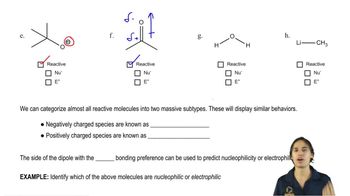
Reactivity of Molecules

Nucleophilic Substitution

Nucleophilic substitution is a fundamental reaction in organic chemistry where a nucleophile replaces a leaving group in a molecule. In the context of benzyl bromide, the bromine atom serves as a leaving group, allowing nucleophiles to attack the carbon atom bonded to it. This concept is essential for understanding how to manipulate benzyl bromide in the synthesis process.
추천 영상:
01:47
Nucleophiles and Electrophiles can react in Substitution Reactions.

Alkene Formation

Alkene formation is a key transformation in organic synthesis, often achieved through elimination reactions or coupling reactions. In this case, the goal is to form a double bond between carbon atoms, which can be accomplished by removing elements from adjacent carbon atoms. Recognizing the mechanisms and conditions that favor alkene formation is vital for successfully proposing a synthetic route.
추천 영상:
가이드 코스
2:09
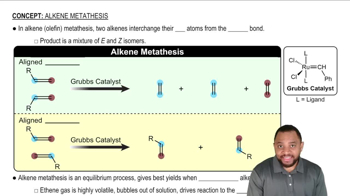
Alkene Metathesis Concept 1