Ch. 20 - Enolates: Carbonyl Addition and Substitution
Mullins - Organic Chemistry: A Learner Centered Approach 1st Edition
Mullins1st EditionOrganic Chemistry: A Learner Centered ApproachISBN: 9780137566471당신이 사용하는 게 아니라요?교과서 변경
19장, 문제 72a

Identify the enolate(s) that would form on treatment of each of the following carbonyls with base. [When there are two possibilities, draw both.]
(a) Chemical structure of a cyclohexanone with a carbonyl group and an attached alkyl chain.

검증된 단계별 안내
1
Identify the alpha carbon(s) adjacent to the carbonyl group in the given ketone structure. The alpha carbon is the one directly connected to the carbonyl carbon.
Determine the number of alpha hydrogens available for deprotonation. In this structure, there are two alpha carbons, each with hydrogens that can be deprotonated.
Consider the base-induced deprotonation of the alpha hydrogen(s) to form the enolate ion. The base will remove an alpha hydrogen, resulting in the formation of a carbanion at the alpha carbon.
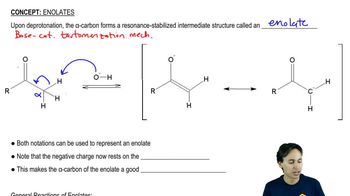
Draw the resonance structures of the enolate ion. The negative charge on the alpha carbon can be delocalized onto the oxygen atom of the carbonyl group, forming a resonance-stabilized enolate.
Since there are two alpha carbons, draw both possible enolates. Each enolate will have a different alpha carbon deprotonated, leading to two distinct enolate structures.

비슷한 문제에 대한 검증된 영상 답변:

이 영상 해법은 위 문제에 도움이 된다고 튜터들이 추천한 것입니다.
영상 길이:
2m

주요 개념

질문에 올바르게 답하기 위해 반드시 이해해야 하는 핵심 개념들은 다음과 같습니다.

Enolate Formation

Enolates are formed when a carbonyl compound, such as a ketone or aldehyde, is treated with a strong base. The base abstracts a proton from the alpha carbon (the carbon adjacent to the carbonyl), resulting in the formation of a resonance-stabilized anion. This process is crucial for understanding nucleophilic addition reactions and the reactivity of carbonyl compounds.
추천 영상:
02:26
Formation of Enolates

Resonance Stabilization

Resonance stabilization refers to the delocalization of electrons across multiple structures, which lowers the energy of the molecule. In the case of enolates, the negative charge can be distributed between the alpha carbon and the carbonyl carbon, creating resonance forms that enhance the stability of the enolate ion. This concept is essential for predicting the reactivity and stability of intermediates in organic reactions.
추천 영상:
03:43
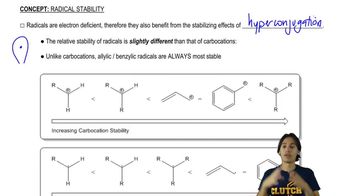
The radical stability trend.

Base Strength and Selectivity

The choice of base in enolate formation affects both the rate of reaction and the type of enolate formed. Strong bases, such as LDA or sodium hydride, can deprotonate carbonyl compounds effectively, while weaker bases may lead to less stable or less reactive enolates. Understanding the strength and selectivity of bases is vital for predicting the outcome of reactions involving carbonyl compounds.
추천 영상:
가이드 코스
2:56
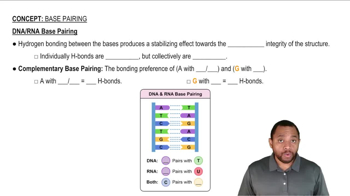
Base Pairing Concept 1