Ch. 20 - Enolates: Carbonyl Addition and Substitution
Mullins - Organic Chemistry: A Learner Centered Approach 1st Edition
Mullins1st EditionOrganic Chemistry: A Learner Centered ApproachISBN: 9780137566471당신이 사용하는 게 아니라요?교과서 변경
19장, 문제 21a

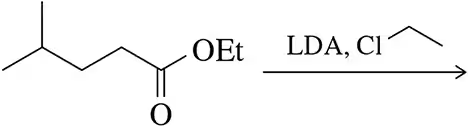
LDA can be used to form enolates on esters and nitriles. Predict the product of these alkylation reactions.
(a) Chemical reaction showing ester with LDA and ethyl chloride, indicating enolate formation and alkylation.

검증된 단계별 안내
1
Step 1: Identify the role of LDA (Lithium Diisopropylamide). LDA is a strong, non-nucleophilic base commonly used to deprotonate the alpha-hydrogen of carbonyl compounds, forming an enolate intermediate.
Step 2: Locate the alpha-hydrogens in the ester compound. Alpha-hydrogens are the hydrogens attached to the carbon adjacent to the carbonyl group. In this case, the alpha-carbon is the one next to the carbonyl group in the ethyl ester.
Step 3: Deprotonation by LDA. LDA will abstract one of the alpha-hydrogens, forming an enolate ion. The enolate is stabilized by resonance between the oxygen of the carbonyl group and the alpha-carbon.
Step 4: Alkylation reaction. The enolate ion acts as a nucleophile and attacks the electrophilic alkyl halide (ethyl chloride, ClCH2CH3). This results in the formation of a new carbon-carbon bond at the alpha-carbon.
Step 5: Predict the product. The final product will be the ester with an ethyl group added to the alpha-carbon. The structure of the product will reflect the new substitution at the alpha-carbon position.

비슷한 문제에 대한 검증된 영상 답변:

이 영상 해법은 위 문제에 도움이 된다고 튜터들이 추천한 것입니다.
영상 길이:
7m

주요 개념

질문에 올바르게 답하기 위해 반드시 이해해야 하는 핵심 개념들은 다음과 같습니다.

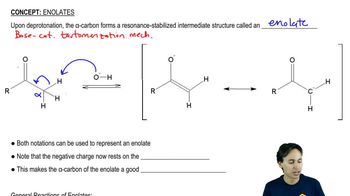
Enolate Formation

Enolates are nucleophilic species formed by the deprotonation of an alpha carbon adjacent to a carbonyl group. In the presence of a strong base like LDA (Lithium diisopropylamide), the hydrogen atom on the alpha carbon is abstracted, resulting in the formation of an enolate ion. This enolate can then act as a nucleophile in subsequent reactions, such as alkylation.
추천 영상:
02:26
Formation of Enolates

Alkylation Reactions

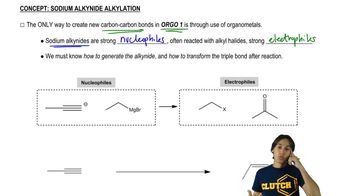
Alkylation involves the introduction of an alkyl group into a molecule, typically through a nucleophilic substitution reaction. In this context, the enolate formed from the ester can attack an alkyl halide, such as ethyl chloride, leading to the formation of a new carbon-carbon bond. This process is crucial for building complex organic molecules and expanding carbon skeletons.
추천 영상:
03:19
Sodium Alkynide Alkylation

Reactivity of Esters and Nitriles

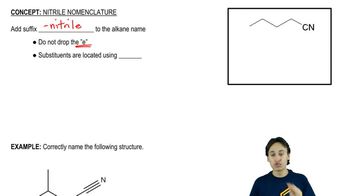
Esters and nitriles can both undergo enolate formation, but their reactivity differs due to the electronic effects of their functional groups. Esters, with their electron-withdrawing carbonyl, can stabilize the enolate formed, making them suitable substrates for alkylation. Nitriles, while also capable of forming enolates, may exhibit different reactivity patterns due to their triple bond and the nature of the leaving group in alkylation reactions.
추천 영상:
01:01
Nitrile Nomenclature