Ch. 21 - Conjugated Systems 1: Stability and Addition Reactions
Mullins - Organic Chemistry: A Learner Centered Approach 1st Edition
Mullins1st EditionOrganic Chemistry: A Learner Centered ApproachISBN: 9780137566471당신이 사용하는 게 아니라요?교과서 변경
20장, 문제 27a

Predict the product of the following addition reactions to dienes.
(a) Chemical structure of a diene with HBrl and heat at 100°C indicating a reaction for predicting addition products.

검증된 단계별 안내
1
Identify the diene structure in the given compound. The compound has two double bonds, which are conjugated, meaning they are separated by a single bond.
Recognize that the reaction involves HBr, a hydrogen halide, and the temperature is 100°C, which suggests that the reaction will proceed via a thermodynamic pathway.
Understand that under thermodynamic conditions, the addition of HBr to a conjugated diene typically results in the formation of the more stable product, which is often the 1,4-addition product.
Consider the mechanism: The HBr will first protonate one of the double bonds, forming a carbocation intermediate. The location of this carbocation is crucial for determining the final product.
Determine the most stable carbocation intermediate, which will lead to the formation of the major product. The bromide ion will then attack the carbocation, resulting in the addition across the diene system.

비슷한 문제에 대한 검증된 영상 답변:

이 영상 해법은 위 문제에 도움이 된다고 튜터들이 추천한 것입니다.

주요 개념

질문에 올바르게 답하기 위해 반드시 이해해야 하는 핵심 개념들은 다음과 같습니다.

Diene Chemistry

Dienes are organic compounds with two double bonds. In addition reactions, the position and conjugation of these double bonds influence the stability and reactivity of intermediates formed. Understanding the structure of dienes is crucial for predicting the outcome of addition reactions, as the arrangement can lead to different regioselectivity and stereoselectivity.
추천 영상:
04:43
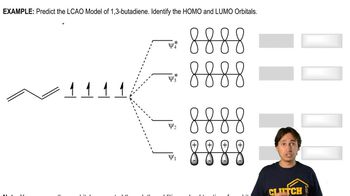
Drawing MO Diagram for Dienes

Electrophilic Addition

Electrophilic addition involves the reaction of an electrophile, such as HBr, with a nucleophile, typically a double bond in organic compounds. The electrophile attacks the electron-rich double bond, forming a carbocation intermediate. The stability of this intermediate is key to determining the major product, as more stable carbocations lead to preferred reaction pathways.
추천 영상:
09:23
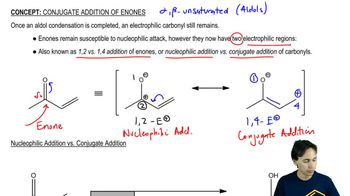
1,2 vs 1,4 Addition

Thermodynamic vs. Kinetic Control

In reactions involving dienes, the product distribution can be influenced by thermodynamic and kinetic control. At high temperatures, such as 100°C, reactions tend to favor thermodynamic control, leading to the most stable product. This concept is essential for predicting the major product in addition reactions, as it explains why certain products are favored under specific conditions.
추천 영상:
08:51
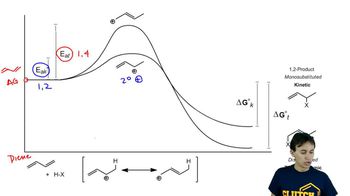
Kinetic vs. Thermodynamic Control