Ch. 21 - Conjugated Systems 1: Stability and Addition Reactions
Mullins - Organic Chemistry: A Learner Centered Approach 1st Edition
Mullins1st EditionOrganic Chemistry: A Learner Centered ApproachISBN: 9780137566471당신이 사용하는 게 아니라요?교과서 변경
20장, 문제 29

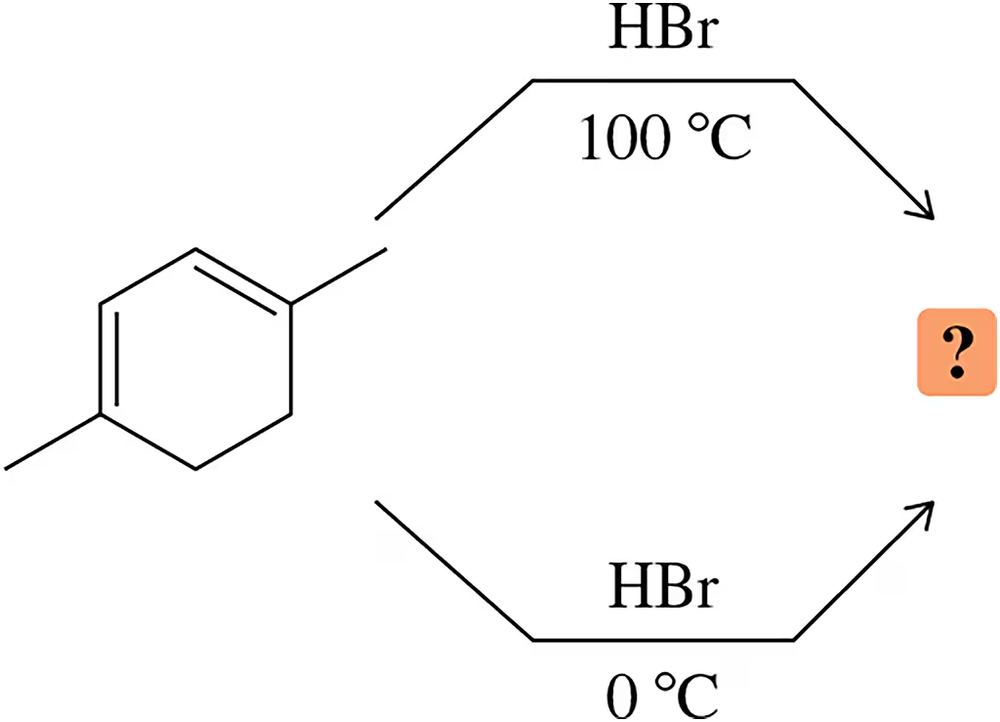
The following diene gives the same product regardless of whether the reaction is run under conditions of kinetic (0 °C) or thermodynamic (100 °C) control. Predict the product and explain this observation.
Chemical reaction diagram showing a diene reacting with HBr at 0°C and 100°C, leading to the same product.

검증된 단계별 안내
1
Identify the structure of the diene. A diene is a hydrocarbon with two double bonds. Determine the position and configuration of these double bonds in the given diene.
Consider the possible reaction pathways. Under kinetic control, reactions favor the formation of the product that forms fastest, often the one with the most stable transition state. Under thermodynamic control, reactions favor the formation of the most stable product.
Analyze the stability of potential products. Look at the possible products formed from the diene and assess their stability. Consider factors such as conjugation, steric hindrance, and hyperconjugation.
Determine why the same product is formed under both conditions. If the diene forms a product that is both kinetically and thermodynamically favored, it will be the major product under both conditions. This can occur if the transition state leading to the most stable product is also the most stable.
Predict the product. Based on the analysis, predict the structure of the product formed from the diene. Consider the stability and formation rate of the product to explain why it is favored under both kinetic and thermodynamic conditions.

비슷한 문제에 대한 검증된 영상 답변:

이 영상 해법은 위 문제에 도움이 된다고 튜터들이 추천한 것입니다.
영상 길이:
2m

주요 개념

질문에 올바르게 답하기 위해 반드시 이해해야 하는 핵심 개념들은 다음과 같습니다.

Kinetic vs. Thermodynamic Control

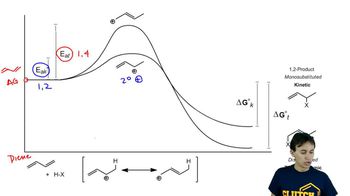
Kinetic control refers to conditions where the reaction pathway with the lowest activation energy predominates, often at lower temperatures, leading to the formation of the fastest-formed product. Thermodynamic control, on the other hand, occurs at higher temperatures where the most stable product is favored, as the system has enough energy to overcome higher activation barriers and reach the most stable state.
추천 영상:
08:51
Kinetic vs. Thermodynamic Control

Diene Reactivity

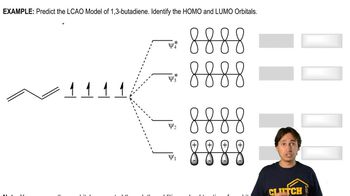
Dienes are compounds with two double bonds, and their reactivity is influenced by the arrangement of these bonds. In reactions like the Diels-Alder reaction, the conformation and substitution pattern of the diene can determine the regioselectivity and stereoselectivity of the product. Understanding the electronic and steric factors that affect diene reactivity is crucial for predicting reaction outcomes.
추천 영상:
04:43
Drawing MO Diagram for Dienes

Reaction Mechanism and Product Stability

The mechanism of a reaction dictates the pathway and intermediates formed, which in turn influence the final product. In this context, the same product under both kinetic and thermodynamic conditions suggests that the product is both the fastest-formed and the most stable. This can occur if the reaction mechanism leads to a single, highly stable product, regardless of the conditions.
추천 영상:
03:43
The radical stability trend.