Ch. 22 - Conjugated Systems 2: Pericyclic Reactions
Mullins - Organic Chemistry: A Learner Centered Approach 1st Edition
Mullins1st EditionOrganic Chemistry: A Learner Centered ApproachISBN: 9780137566471당신이 사용하는 게 아니라요?교과서 변경
21장, 문제 3a

Draw the molecular orbital picture for (a) ethene. Label the HOMO and LUMO of each.

검증된 단계별 안내
1
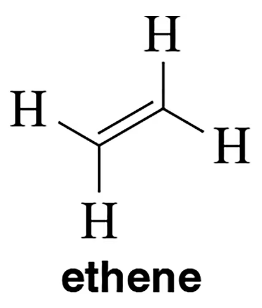
Step 1: Ethene (C2H4) consists of a double bond between two carbon atoms. The double bond is made up of one sigma (σ) bond and one pi (π) bond. The sigma bond is formed by the overlap of sp² hybrid orbitals, while the pi bond is formed by the sideways overlap of unhybridized p orbitals.
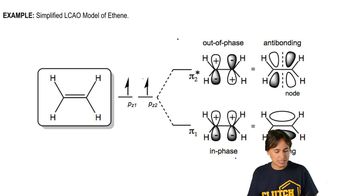
Step 2: To draw the molecular orbital picture for ethene, start by representing the bonding and antibonding molecular orbitals for the π system. The two p orbitals from the carbon atoms combine to form two molecular orbitals: a bonding π orbital (lower energy) and an antibonding π* orbital (higher energy).
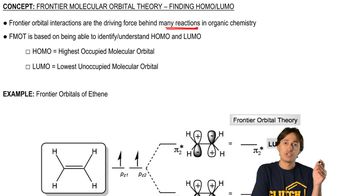
Step 3: Label the Highest Occupied Molecular Orbital (HOMO) and Lowest Unoccupied Molecular Orbital (LUMO). In ethene, the bonding π orbital is the HOMO because it contains the electrons from the π bond. The antibonding π* orbital is the LUMO because it is the next available orbital that does not contain electrons.
Step 4: Represent the π bonding orbital as a region of electron density above and below the plane of the molecule, showing constructive overlap of the p orbitals. Represent the π* antibonding orbital with nodes (regions of zero electron density) between the carbon atoms, indicating destructive overlap.
Step 5: Ensure the molecular orbital diagram clearly shows the energy levels of the π and π* orbitals, with the π orbital lower in energy than the π* orbital. Label the HOMO and LUMO explicitly in the diagram to complete the molecular orbital picture for ethene.

비슷한 문제에 대한 검증된 영상 답변:

이 영상 해법은 위 문제에 도움이 된다고 튜터들이 추천한 것입니다.

주요 개념

질문에 올바르게 답하기 위해 반드시 이해해야 하는 핵심 개념들은 다음과 같습니다.

Molecular Orbitals

Molecular orbitals (MOs) are formed by the combination of atomic orbitals when atoms bond together. In ethene (C2H4), the π bonds are created from the overlap of p orbitals, resulting in bonding and antibonding molecular orbitals. Understanding how these orbitals are formed and their energy levels is crucial for analyzing the electronic structure of the molecule.
추천 영상:
08:41
Review of Molecular Orbitals

HOMO and LUMO

The Highest Occupied Molecular Orbital (HOMO) is the molecular orbital that contains the highest energy electrons, while the Lowest Unoccupied Molecular Orbital (LUMO) is the lowest energy orbital that is unoccupied. In ethene, the HOMO is typically a π orbital, and the LUMO is the corresponding π* antibonding orbital. Identifying these orbitals is essential for predicting reactivity and electronic transitions.
추천 영상:
02:35
HOMO vs. LUMO

Ethene Structure

Ethene, or ethylene, is a simple alkene with a double bond between two carbon atoms. This double bond consists of one σ bond and one π bond, which influences the molecule's geometry and reactivity. Understanding the structure of ethene is fundamental for drawing its molecular orbital diagram and labeling the HOMO and LUMO accurately.
추천 영상:
03:04
Drawing Resonance Structures