

Ch. 22 - Conjugated Systems 2: Pericyclic Reactions
Mullins - Organic Chemistry: A Learner Centered Approach 1st Edition
Mullins1st EditionOrganic Chemistry: A Learner Centered ApproachISBN: 9780137566471당신이 사용하는 게 아니라요?교과서 변경
21장, 문제 53

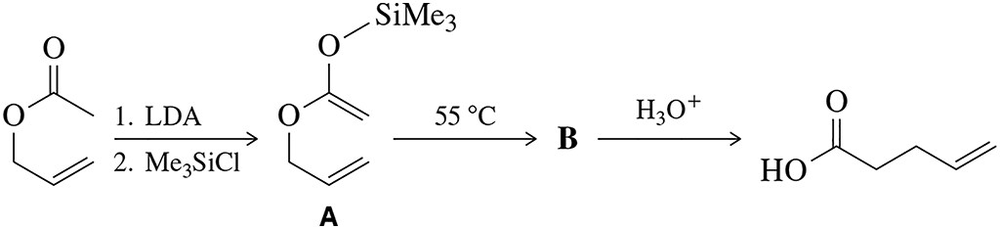
The Ireland–Claisen reaction is a variant of the Claisen reaction studied in this chapter.
(a) Suggest a mechanism for the first step.
(b) Predict the product (B) that would result from heating intermediate A.
(c) Hydrolysis of B gives a carboxylic acid.
Suggest a mechanism for this reaction.
Chemical reaction mechanism diagram illustrating the Ireland–Claisen reaction with labeled steps and intermediates.

검증된 단계별 안내
1
The first step involves the deprotonation of the alpha hydrogen of the ester by LDA (Lithium diisopropylamide), a strong base, to form an enolate ion. This is a common step in reactions involving carbonyl compounds to generate nucleophilic enolates.
The enolate ion then reacts with trimethylsilyl chloride (Me3SiCl) to form a silyl enol ether. This step involves the nucleophilic attack of the enolate oxygen on the silicon atom, resulting in the formation of intermediate A.
Upon heating, intermediate A undergoes a [3,3]-sigmatropic rearrangement, known as the Ireland–Claisen rearrangement. This rearrangement involves the migration of the allyl group to the oxygen atom, forming a new carbon-carbon bond and resulting in the formation of product B.
The product B, which is an ester, undergoes hydrolysis in the presence of an acid (H3O+). This involves the nucleophilic attack of water on the carbonyl carbon, followed by proton transfers and the elimination of an alcohol, leading to the formation of a carboxylic acid.
The final product of the hydrolysis is a carboxylic acid, which is formed by the cleavage of the ester linkage in product B. This step completes the transformation of the initial ester into a carboxylic acid.

비슷한 문제에 대한 검증된 영상 답변:

이 영상 해법은 위 문제에 도움이 된다고 튜터들이 추천한 것입니다.
영상 길이:
6m

주요 개념

질문에 올바르게 답하기 위해 반드시 이해해야 하는 핵심 개념들은 다음과 같습니다.

Ireland–Claisen Rearrangement

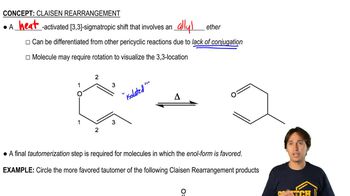
The Ireland–Claisen rearrangement is a variant of the Claisen rearrangement involving silyl enol ethers. It typically involves the conversion of an allyl ester to a γ,δ-unsaturated carboxylic acid. The reaction proceeds through a six-membered cyclic transition state, allowing for the migration of the allyl group and formation of a new carbon-carbon bond.
추천 영상:
06:08
Definition of Claisen Rearrangement

Silyl Enol Ether Formation

Silyl enol ethers are formed by the reaction of enolates with silyl chlorides, such as trimethylsilyl chloride (Me3SiCl). In the Ireland–Claisen rearrangement, lithium diisopropylamide (LDA) is used to generate the enolate, which then reacts with Me3SiCl to form the silyl enol ether. This intermediate is crucial for the rearrangement process, as it stabilizes the enolate and facilitates the subsequent rearrangement.
추천 영상:
02:26
Formation of Enolates

Hydrolysis of Esters

Hydrolysis of esters involves the conversion of an ester into a carboxylic acid and an alcohol, typically under acidic or basic conditions. In the context of the Ireland–Claisen rearrangement, the hydrolysis of the rearranged product (B) leads to the formation of a carboxylic acid. Acidic hydrolysis involves protonation of the ester, followed by nucleophilic attack by water, leading to the cleavage of the ester bond and formation of the carboxylic acid.
추천 영상:
가이드 코스
0:48
Hydrolysis of Phosphate Esters Concept 2