Ch. 22 - Conjugated Systems 2: Pericyclic Reactions
Mullins - Organic Chemistry: A Learner Centered Approach 1st Edition
Mullins1st EditionOrganic Chemistry: A Learner Centered ApproachISBN: 9780137566471당신이 사용하는 게 아니라요?교과서 변경
21장, 문제 55

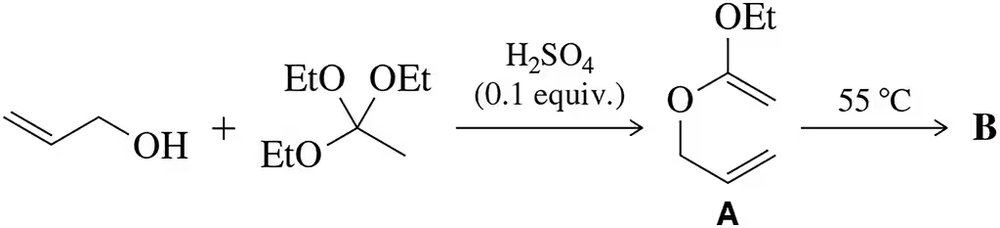
The Johnson–Claisen reaction is a variant of the Claisen reaction studied in this chapter. (a) Suggest a mechanism for the first step. (b) Predict the product (B) that would result from heating intermediate A.
Chemical reaction diagram showing reactants, intermediate A, and product B with conditions for the Johnson–Claisen reaction.

검증된 단계별 안내
1
The Johnson–Claisen rearrangement involves the conversion of an allylic alcohol to an allylic ester. In the first step, the allylic alcohol reacts with the orthoester in the presence of a catalytic amount of acid (H2SO4) to form an intermediate hemiacetal.
The acid catalyzes the formation of the hemiacetal by protonating the orthoester, making it more electrophilic and susceptible to nucleophilic attack by the alcohol.
Once the hemiacetal is formed, it undergoes a rearrangement. The allylic group migrates to the oxygen atom, forming a new carbon-oxygen bond and resulting in the formation of an enol ether intermediate (A).
Upon heating, the enol ether intermediate (A) undergoes a [3,3]-sigmatropic rearrangement, which is characteristic of the Claisen rearrangement. This rearrangement involves the migration of the allylic group and the formation of a new carbon-carbon bond.
The final product (B) is an allylic ester, which is formed after the rearrangement and subsequent tautomerization of the enol ether intermediate.

비슷한 문제에 대한 검증된 영상 답변:

이 영상 해법은 위 문제에 도움이 된다고 튜터들이 추천한 것입니다.

주요 개념

질문에 올바르게 답하기 위해 반드시 이해해야 하는 핵심 개념들은 다음과 같습니다.

Johnson–Claisen Reaction

The Johnson–Claisen reaction is a variant of the Claisen rearrangement, involving the conversion of allylic alcohols into γ,δ-unsaturated carbonyl compounds. This reaction typically involves the use of an orthoester and an acid catalyst, leading to the formation of an intermediate enol ether, which rearranges to form the final product. Understanding this reaction is crucial for predicting the transformation of intermediate A to product B.
추천 영상:
02:10
Claisen-Schmidt Reaction

Mechanism of the Johnson–Claisen Reaction

The mechanism begins with the protonation of the orthoester by the acid catalyst, followed by nucleophilic attack by the allylic alcohol, leading to the formation of an enol ether intermediate. This intermediate undergoes a [3,3]-sigmatropic rearrangement, resulting in the formation of a γ,δ-unsaturated carbonyl compound. Recognizing these steps helps in suggesting the mechanism for the first step of the reaction.
추천 영상:
02:10
Claisen-Schmidt Reaction

Sigmatropic Rearrangement

A sigmatropic rearrangement is a pericyclic reaction where a sigma bond adjacent to one or more pi systems migrates across the pi system. In the Johnson–Claisen reaction, a [3,3]-sigmatropic rearrangement occurs, where the enol ether intermediate rearranges to form a new carbon-carbon bond, leading to the formation of the final product. This concept is essential for predicting the structure of product B from intermediate A.
추천 영상:
03:20
Nomenclature of Sigmatropic Shifts