Ch. 24 - Benzene 2: Reactions Influenced by the Aromatic Ring
Mullins - Organic Chemistry: A Learner Centered Approach 1st Edition
Mullins1st EditionOrganic Chemistry: A Learner Centered ApproachISBN: 9780137566471당신이 사용하는 게 아니라요?교과서 변경
23장, 문제 53

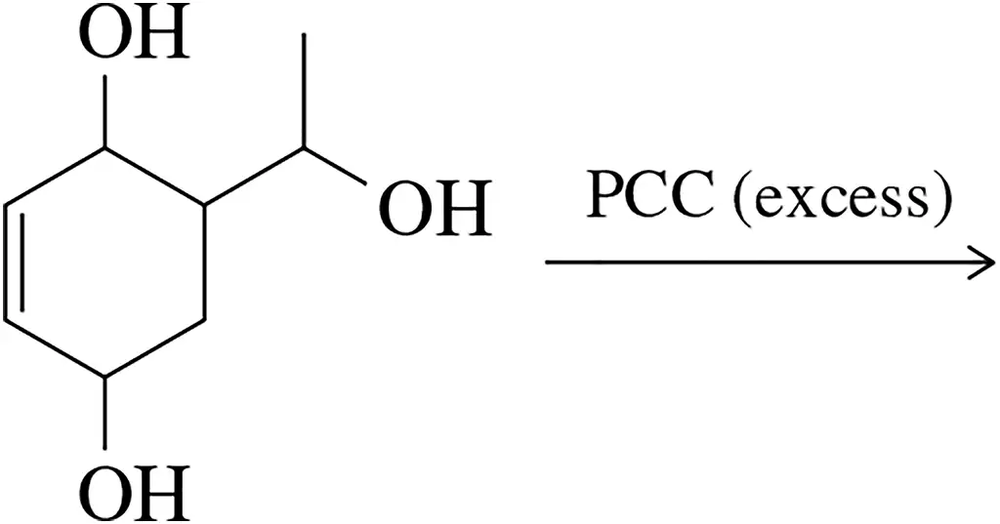
Identify the aromatic product that would result from the oxidation of the triol with an excess of PCC.
Chemical structure of a triol with three hydroxyl groups, indicating oxidation with excess PCC to form an aromatic product.

검증된 단계별 안내
1
Identify the functional groups present in the starting material. The compound is a triol, meaning it has three hydroxyl (OH) groups attached to a cyclohexane ring.
Understand the role of PCC (Pyridinium Chlorochromate) in oxidation reactions. PCC is a mild oxidizing agent that can oxidize primary alcohols to aldehydes and secondary alcohols to ketones without further oxidation to carboxylic acids.
Consider the structure of the triol. The hydroxyl groups are attached to a cyclohexane ring, which can be oxidized to form carbonyl groups (either aldehydes or ketones).
Recognize that the presence of excess PCC suggests that all oxidizable alcohol groups will be converted to carbonyl groups. In this case, the triol will be oxidized to a compound with three carbonyl groups.
Determine the final structure. The oxidation of the triol with excess PCC will result in the formation of a compound with three ketone groups, which can undergo further rearrangement to form an aromatic compound, such as a quinone, due to the stabilization provided by the aromaticity.

비슷한 문제에 대한 검증된 영상 답변:

이 영상 해법은 위 문제에 도움이 된다고 튜터들이 추천한 것입니다.

주요 개념

질문에 올바르게 답하기 위해 반드시 이해해야 하는 핵심 개념들은 다음과 같습니다.

Oxidation with PCC

Pyridinium chlorochromate (PCC) is a reagent used to oxidize alcohols to carbonyl compounds. In excess, PCC can further oxidize primary alcohols to carboxylic acids and secondary alcohols to ketones. Understanding the role of PCC in transforming hydroxyl groups is crucial for predicting the final aromatic product in this reaction.
추천 영상:
05:53
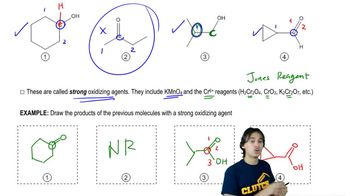
Strong oxidizing agents

Aromaticity

Aromatic compounds are characterized by their cyclic, planar structure with conjugated pi electrons following Huckel's rule (4n+2 pi electrons). The transformation of the triol into an aromatic product involves the formation of a stable, conjugated ring system. Recognizing the conditions that lead to aromaticity is essential for identifying the final product.
추천 영상:
08:19
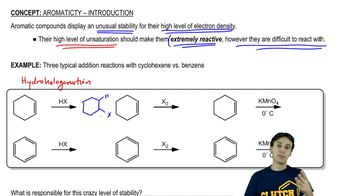
Intro to Aromaticity

Triol Structure

A triol is a molecule containing three hydroxyl groups. In the given structure, these groups are attached to a cyclohexane ring. The oxidation process will convert these hydroxyl groups into carbonyl groups, facilitating the formation of an aromatic compound. Understanding the initial structure helps in predicting the changes during the reaction.
추천 영상:
03:04
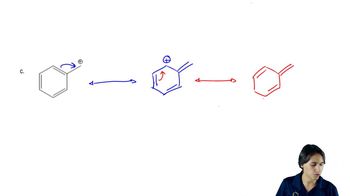
Drawing Resonance Structures