


Ch. 24 - Benzene 2: Reactions Influenced by the Aromatic Ring
Mullins - Organic Chemistry: A Learner Centered Approach 1st Edition
Mullins1st EditionOrganic Chemistry: A Learner Centered ApproachISBN: 9780137566471당신이 사용하는 게 아니라요?교과서 변경
23장, 문제 55

Rationalize the ranking of increasing reaction rate of the benzylic halides shown.
Chemical structures of benzylic halides arranged from left to right, indicating increasing reaction rates with a green arrow.

검증된 단계별 안내
1
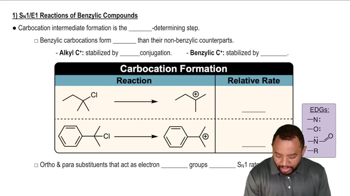
Analyze the structure of the benzylic halides provided. Benzylic halides are compounds where a halogen atom is attached to a benzylic carbon, which is the carbon directly adjacent to a benzene ring. The reaction rate is influenced by the stability of the carbocation formed during the reaction.
Consider the mechanism of the reaction. Benzylic halides typically undergo reactions such as SN1 or SN2. In an SN1 reaction, the rate depends on the stability of the carbocation intermediate, while in an SN2 reaction, steric hindrance and the accessibility of the electrophilic carbon play a significant role.
Evaluate the substituents on the benzene ring and the benzylic carbon. Electron-donating groups (e.g., -CH3, -OCH3) on the benzene ring stabilize the carbocation intermediate through resonance, increasing the reaction rate. Electron-withdrawing groups (e.g., -NO2, -CF3) destabilize the carbocation, decreasing the reaction rate.
Assess the steric hindrance around the benzylic carbon. For SN2 reactions, bulky substituents near the benzylic carbon can slow down the reaction by making it harder for the nucleophile to attack.
Rank the benzylic halides based on the combined effects of carbocation stability (for SN1) and steric hindrance (for SN2). Consider the electronic effects of substituents and the accessibility of the benzylic carbon to rationalize the order of increasing reaction rate.

비슷한 문제에 대한 검증된 영상 답변:

이 영상 해법은 위 문제에 도움이 된다고 튜터들이 추천한 것입니다.
영상 길이:
7m

주요 개념

질문에 올바르게 답하기 위해 반드시 이해해야 하는 핵심 개념들은 다음과 같습니다.

Benzylic Halides

Benzylic halides are organic compounds where a halogen atom is attached to a carbon atom that is directly bonded to a benzene ring. This structure allows for resonance stabilization, which can significantly influence the reactivity of the halide. The presence of the aromatic ring can stabilize the transition state during reactions, making benzylic halides generally more reactive than their aliphatic counterparts.
추천 영상:
가이드 코스
2:46
Reactions at Benzylic Positions Concept 2

Reaction Mechanisms

Understanding the reaction mechanisms, particularly nucleophilic substitution (SN1 and SN2), is crucial for rationalizing reaction rates. In SN1 reactions, the rate-determining step involves the formation of a carbocation, which is more stable for benzylic halides due to resonance. In contrast, SN2 reactions involve a direct attack by the nucleophile, where steric hindrance plays a significant role in determining the reaction rate.
추천 영상:
02:16
Heck Reaction Mechanism

Carbocation Stability

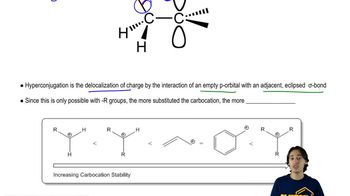
Carbocation stability is a key factor in determining the reaction rates of benzylic halides. Benzylic carbocations are particularly stable due to resonance, as the positive charge can be delocalized into the aromatic ring. This stability leads to faster reaction rates in mechanisms that involve carbocation formation, such as SN1 reactions, compared to less stable carbocations formed from primary or secondary halides.
추천 영상:
05:58
Determining Carbocation Stability