Ch. 24 - Benzene 2: Reactions Influenced by the Aromatic Ring
Mullins - Organic Chemistry: A Learner Centered Approach 1st Edition
Mullins1st EditionOrganic Chemistry: A Learner Centered ApproachISBN: 9780137566471당신이 사용하는 게 아니라요?교과서 변경
23장, 문제 21

In light of Figure 24.22, provide a mechanism by which para-dihydroxybenzene is oxidized to para-quinone.
Chemical reaction diagram showing the oxidation of para-dihydroxybenzene to para-quinone using H2CrO4 in water.

검증된 단계별 안내
1
Identify the starting material as para-dihydroxybenzene, which has two hydroxyl groups attached to a benzene ring in the para position.
Recognize the oxidizing agent as chromic acid (H₂CrO₄), which is commonly used to oxidize alcohols to carbonyl compounds.
Understand that the mechanism involves the oxidation of the hydroxyl groups to carbonyl groups, forming para-quinone.
Propose that the first step involves the formation of a chromate ester intermediate, where the hydroxyl oxygen attacks the chromium atom, forming a bond and releasing water.
Suggest that the chromate ester undergoes a two-electron oxidation, where the C-O bond is cleaved, forming a carbonyl group and reducing the chromium species, resulting in the formation of para-quinone.

비슷한 문제에 대한 검증된 영상 답변:

이 영상 해법은 위 문제에 도움이 된다고 튜터들이 추천한 것입니다.

주요 개념

질문에 올바르게 답하기 위해 반드시 이해해야 하는 핵심 개념들은 다음과 같습니다.

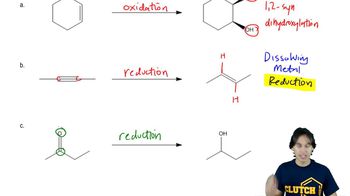
Oxidation-Reduction Reactions

Oxidation-reduction (redox) reactions involve the transfer of electrons between species, leading to changes in oxidation states. In the context of organic chemistry, oxidation often refers to the loss of hydrogen or the gain of oxygen, while reduction is the opposite. Understanding these processes is crucial for analyzing how para-dihydroxybenzene can be converted to para-quinone through the removal of electrons and protons.
추천 영상:
00:54
Distinguishing between Oxidation and Reduction

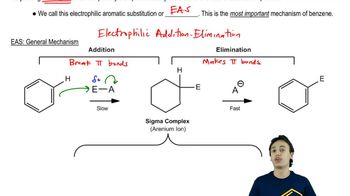
Mechanism of Electrophilic Aromatic Substitution

Electrophilic aromatic substitution (EAS) is a fundamental reaction mechanism in organic chemistry where an electrophile replaces a hydrogen atom on an aromatic ring. In the case of para-dihydroxybenzene, the hydroxyl groups can activate the ring towards electrophilic attack, facilitating the formation of para-quinone. Recognizing the role of substituents in directing the reaction is essential for understanding the mechanism involved.
추천 영상:
06:52
EAS General Mechanism

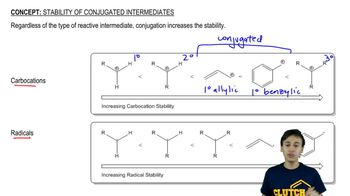
Resonance and Stability of Intermediates

Resonance refers to the delocalization of electrons within a molecule, which can stabilize reaction intermediates. In the oxidation of para-dihydroxybenzene, the formation of a resonance-stabilized carbocation intermediate is key to the reaction pathway. Understanding how resonance affects the stability of intermediates helps predict the feasibility and outcome of the oxidation process leading to para-quinone.
추천 영상:
04:31
Stability of Conjugated Intermediates