Ch. 24 - Benzene 2: Reactions Influenced by the Aromatic Ring
Mullins - Organic Chemistry: A Learner Centered Approach 1st Edition
Mullins1st EditionOrganic Chemistry: A Learner Centered ApproachISBN: 9780137566471당신이 사용하는 게 아니라요?교과서 변경
23장, 문제 18d

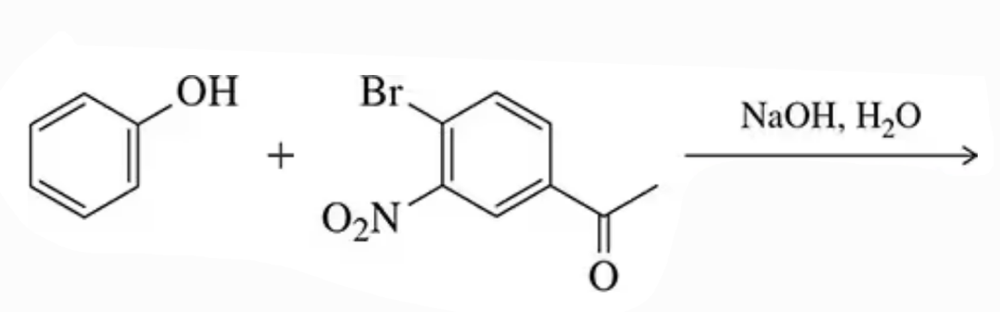
Predict the product of the following substitution/addition reactions involving phenoxides. [Because this problem represents a review of current and previous material, section numbers have been provided for your reference.]
(d) Chemical reaction diagram showing phenoxide and brominated compound reacting with sodium hydroxide and water.

검증된 단계별 안내
1
Step 1: Analyze the reactants. The first reactant is phenol (C6H5OH), which can form phenoxide ions when treated with a strong base like NaOH. The second reactant is 4-bromo-3-nitrobenzoyl chloride, which contains an electrophilic carbonyl group and a bromine atom attached to the aromatic ring.
Step 2: Understand the role of NaOH. NaOH will deprotonate the phenol to form the phenoxide ion (C6H5O⁻), which is a strong nucleophile. This nucleophile can attack electrophilic centers in the second reactant.
Step 3: Identify the electrophilic site in the second reactant. The carbonyl carbon in the benzoyl chloride group is highly electrophilic due to the electron-withdrawing effects of the nitro group and the chlorine atom. This makes it susceptible to nucleophilic attack by the phenoxide ion.
Step 4: Predict the mechanism. The phenoxide ion will attack the carbonyl carbon of the benzoyl chloride group, leading to the formation of a tetrahedral intermediate. The chloride ion (Cl⁻) will then leave, resulting in the formation of an ester bond between the phenoxide and the benzoyl group.
Step 5: Consider the final product. The substitution reaction will yield a compound where the phenoxide group is attached to the benzoyl group, forming an ester. The bromine and nitro groups on the aromatic ring remain unchanged.

비슷한 문제에 대한 검증된 영상 답변:

이 영상 해법은 위 문제에 도움이 된다고 튜터들이 추천한 것입니다.

주요 개념

질문에 올바르게 답하기 위해 반드시 이해해야 하는 핵심 개념들은 다음과 같습니다.

Phenoxide Ion

A phenoxide ion is formed when phenol (C6H5OH) loses a proton (H+) from its hydroxyl group, resulting in a negatively charged ion (C6H5O-). This ion is a strong nucleophile due to the resonance stabilization provided by the aromatic ring, making it highly reactive in substitution and addition reactions.
추천 영상:
가이드 코스
3:39
Metal Ion Catalysis Concept 1

Nucleophilic Aromatic Substitution (NAS)

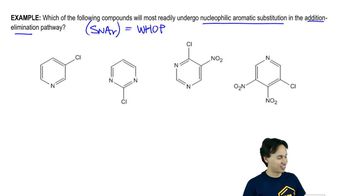
Nucleophilic aromatic substitution is a reaction where a nucleophile replaces a leaving group on an aromatic ring. This process is facilitated by the presence of electron-withdrawing groups, such as nitro (NO2) or halogens, which stabilize the negative charge in the intermediate Meisenheimer complex, allowing the nucleophile to attack the aromatic system.
추천 영상:
02:10
NAS in the addition-elimination pathway

Reactivity of Aromatic Compounds

Aromatic compounds exhibit unique reactivity patterns due to their stable resonance structures. The presence of substituents can significantly influence the reactivity; electron-donating groups enhance nucleophilicity, while electron-withdrawing groups can facilitate nucleophilic attacks. Understanding these effects is crucial for predicting the outcomes of reactions involving aromatic systems.
추천 영상:
08:19
Intro to Aromaticity