The first amino acid in the pentapeptide of Figure 26.50, Pyr, is not one of the 20 amino acids in Table 26.1. Based on the following structure of Pyr, from which natural amino acid is it likely derived?
Ch. 26 - Amino Acids, Proteins, and Peptide Synthesis

Mullins1st EditionOrganic Chemistry: A Learner Centered ApproachISBN: 9780137566471당신이 사용하는 게 아니라요?교과서 변경
25장, 문제 28
Provide a mechanism for the protection of the amine as the benzylcarbamate shown in Figure 26.33(a). <IMAGE>
검증된 단계별 안내1
Identify the amine group in the molecule that needs to be protected. The amine group typically contains a nitrogen atom bonded to hydrogen atoms or alkyl groups.
Select the protecting group for the amine. In this case, the benzylcarbamate group is used, which is derived from benzyl chloroformate.
React the amine with benzyl chloroformate. This reaction typically occurs in the presence of a base, such as triethylamine, to neutralize the hydrochloric acid byproduct and facilitate the formation of the carbamate linkage.
The mechanism involves the nucleophilic attack of the nitrogen atom of the amine on the carbonyl carbon of the benzyl chloroformate, forming a tetrahedral intermediate.
The intermediate collapses, expelling the chloride ion and forming the benzylcarbamate-protected amine. This step completes the protection of the amine group.

비슷한 문제에 대한 검증된 영상 답변:
이 영상 해법은 위 문제에 도움이 된다고 튜터들이 추천한 것입니다.
영상 길이:
2m주요 개념
질문에 올바르게 답하기 위해 반드시 이해해야 하는 핵심 개념들은 다음과 같습니다.
Amine Protection
Amine protection is a strategy used in organic synthesis to temporarily mask the reactivity of an amine group. This is crucial when multiple functional groups are present, and selective reactions are needed. Protecting groups, like benzylcarbamate, are introduced to prevent unwanted reactions at the amine site, allowing for selective transformations elsewhere in the molecule.
추천 영상:
Acetal Protecting Group
Benzylcarbamate Formation
Benzylcarbamate is a common protecting group for amines, formed by reacting an amine with benzyl chloroformate. This reaction typically involves nucleophilic attack by the amine on the carbonyl carbon of benzyl chloroformate, followed by the release of hydrochloric acid. The resulting benzylcarbamate is stable under a variety of conditions, making it a versatile choice for protection.
추천 영상:
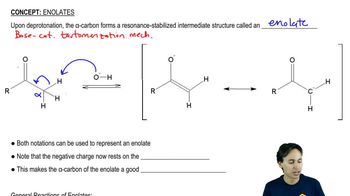
Formation of Enolates
Reaction Mechanism
Understanding the reaction mechanism involves detailing the step-by-step process by which reactants are converted to products. For amine protection with benzylcarbamate, the mechanism includes nucleophilic attack, formation of a tetrahedral intermediate, and subsequent elimination of a leaving group. This mechanistic insight is essential for predicting reaction outcomes and troubleshooting synthetic challenges.
추천 영상:
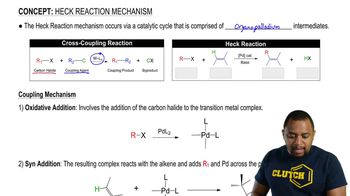
Heck Reaction Mechanism
관련 실천
교과서 질문
778
views
교과서 질문
Why are conjugated molecules like the product of the ninhydrin reaction brightly colored?
1108
views
교과서 질문
Calculate the equilibrium constant for the reaction of ethylamine and propanoic acid. Which side is favored?
997
views
교과서 질문
Draw the following amino acids in all possible protonation states as you move from high pH to low pH.
b. His
852
views
교과서 질문
Although there is free rotation around most σ bonds, rotation is restricted around the C--N bond of an amide. Explain why this is true.
1552
views
교과서 질문
Provide a synthesis of the following amino acids using a combination of the HVZ and amination reactions.
b. Leu
856
views