Ch. 3 - Alkanes and Cycloalkanes: Properties and Conformational Analysis
Mullins - Organic Chemistry: A Learner Centered Approach 1st Edition
Mullins1st EditionOrganic Chemistry: A Learner Centered ApproachISBN: 9780137566471당신이 사용하는 게 아니라요?교과서 변경
2장, 문제 45a

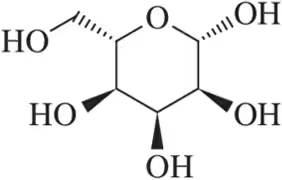
Modify the following line-angle drawings to show all lone pairs.
(a) Line-angle drawing of a hexagonal molecule with hydroxyl groups, indicating where lone pairs should be added.

검증된 단계별 안내
1
Step 1: Identify all atoms in the line-angle drawing. Remember that in line-angle structures, carbon atoms are implied at the vertices and ends of lines, and hydrogen atoms bonded to carbon are not explicitly shown.
Step 2: Determine the valence electrons for each atom. For example, oxygen has 6 valence electrons, nitrogen has 5, and halogens like chlorine have 7. Carbon typically forms 4 bonds, and hydrogen forms 1 bond.
Step 3: Analyze the bonding around each atom. For atoms that do not have a full octet or are not involved in bonding, add lone pairs to satisfy the octet rule. For example, oxygen typically has 2 bonds and 2 lone pairs.
Step 4: Add lone pairs to heteroatoms (non-carbon atoms) such as oxygen, nitrogen, or halogens. Ensure that the total number of electrons around each atom matches its valence electron count.
Step 5: Double-check the structure to ensure that all atoms have the correct number of bonds and lone pairs, and that the octet rule is satisfied for atoms that require it.

비슷한 문제에 대한 검증된 영상 답변:

이 영상 해법은 위 문제에 도움이 된다고 튜터들이 추천한 것입니다.
영상 길이:
2m

주요 개념

질문에 올바르게 답하기 위해 반드시 이해해야 하는 핵심 개념들은 다음과 같습니다.

Line-Angle Drawings

Line-angle drawings, also known as skeletal structures, are a simplified way to represent organic molecules. In these drawings, vertices represent carbon atoms, and lines represent bonds between them. Hydrogen atoms attached to carbons are usually omitted for clarity, but understanding these structures is crucial for visualizing molecular geometry and connectivity.
추천 영상:
02:46
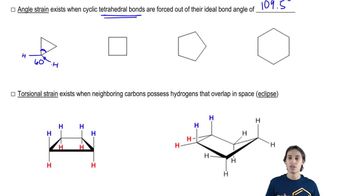
What is angle strain?

Lone Pairs

Lone pairs are pairs of valence electrons that are not involved in bonding and are localized on a single atom. They play a significant role in determining the shape and reactivity of molecules. Recognizing and representing lone pairs in molecular structures is essential for predicting molecular geometry and understanding intermolecular interactions.
추천 영상:
02:04
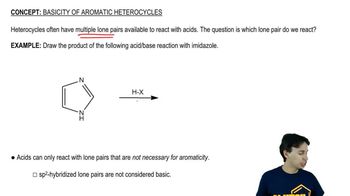
Heterocycles - Which lone pairs react?

Molecular Geometry

Molecular geometry refers to the three-dimensional arrangement of atoms within a molecule. It is influenced by the presence of lone pairs and bonding pairs of electrons, which can affect bond angles and overall shape. Understanding molecular geometry is vital for predicting the physical and chemical properties of substances, including polarity and reactivity.
추천 영상:
07:44
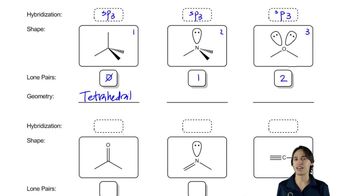
Molecular Geometry Explained.