
교과서 질문
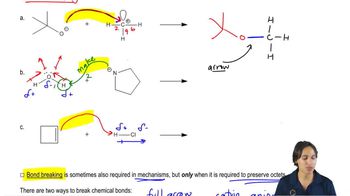
For each of the following reactions, identify the bonds that are broken and formed. Be sure to indicate whether the bond that is broken is a σ bond or a π bond.
(a)
1086
views


 검증된 단계별 안내
 3:11
3:11
 02:31
02:31 02:16
02:16For each of the following reactions, identify the bonds that are broken and formed. Be sure to indicate whether the bond that is broken is a σ bond or a π bond.
(a)
For each of the following reactions, identify the bonds that are broken and formed. Be sure to indicate whether the bond that is broken is a σ bond or a π bond.
(e)
The A value of a substituent on a cyclohexane ring is essentially the ∆G° for a substituent going from the equatorial to the axial position in a chair–chair interconversion. Because most substituents prefer to be in the equatorial position, A values are, by definition, positive numbers. Use the table of A values to calculate ∆G° and Keq for the chair–chair interconversions shown.
(b)
For each of the following acid–base reactions, (ii) calculate Keq. If a pKa is not one of the ten common ones we learned in Chapter 4, it will be given to you.
(a)
For each of the following acid–base reactions, (iii) calculate ∆G°. If a pKa is not one of the ten common ones we learned in Chapter 4, it will be given to you.
(a)
The A value of a substituent on a cyclohexane ring is essentially the ∆G° for a substituent going from the equatorial to the axial position in a chair–chair interconversion. Because most substituents prefer to be in the equatorial position, A values are, by definition, positive numbers. Use the table of A values to calculate ∆G° and Keq for the chair–chair interconversions shown.
(a)