Ch. 5 - Chemical Reaction Analysis: Thermodynamics and Kinetics
Mullins - Organic Chemistry: A Learner Centered Approach 1st Edition
Mullins1st EditionOrganic Chemistry: A Learner Centered ApproachISBN: 9780137566471당신이 사용하는 게 아니라요?교과서 변경
4장, 문제 59c

Reaction (c), on the other hand, is favored (∆G° < 0). Identify the bonds formed and broken and explain this result in light of (a) and (b).
(c) Chemical reaction diagram showing the conversion between two molecular structures with bonds indicated.

검증된 단계별 안내
1
Identify the bonds broken and formed in reaction (c). For example, analyze the reactants and products to determine which bonds are cleaved and which new bonds are created. Use structural formulas to visualize this process.
Recall that the Gibbs free energy change (∆G°) is related to the bond energies of the bonds broken and formed. Breaking bonds requires energy (endothermic), while forming bonds releases energy (exothermic).
Compare the bond energies of the bonds broken and formed. If the bonds formed are stronger (have higher bond energy) than the bonds broken, the reaction will release energy, making ∆G° negative and the reaction thermodynamically favorable.
Relate this result to reactions (a) and (b). Consider whether the same types of bonds are involved and whether the energy changes in (c) are consistent with the trends observed in (a) and (b).
Conclude by explaining why reaction (c) is favored (∆G° < 0) based on the net energy change from bond breaking and forming, and how this aligns with the thermodynamic principles of exergonic reactions.

비슷한 문제에 대한 검증된 영상 답변:

이 영상 해법은 위 문제에 도움이 된다고 튜터들이 추천한 것입니다.
영상 길이:
8m

주요 개념

질문에 올바르게 답하기 위해 반드시 이해해야 하는 핵심 개념들은 다음과 같습니다.

Gibbs Free Energy (∆G)

Gibbs Free Energy (∆G) is a thermodynamic potential that measures the maximum reversible work obtainable from a thermodynamic system at constant temperature and pressure. A negative value of ∆G (∆G° < 0) indicates that a reaction is spontaneous, meaning it can occur without external energy input. Understanding this concept is crucial for analyzing the favorability of chemical reactions and predicting their direction.
추천 영상:
05:02
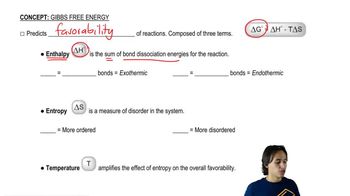
Breaking down the different terms of the Gibbs Free Energy equation.

Bond Formation and Breaking

In chemical reactions, bonds between atoms are either formed or broken, which directly influences the energy changes in the system. When bonds are formed, energy is released, contributing to a negative ∆G, while breaking bonds requires energy input. Identifying which specific bonds are involved in the reaction helps in understanding the overall energy dynamics and the reaction's favorability.
추천 영상:
02:31
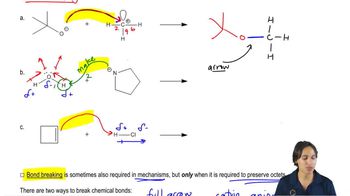
Identifying Bond Breaking

Reaction Mechanism

A reaction mechanism describes the step-by-step sequence of elementary reactions by which overall chemical change occurs. It provides insight into how reactants transform into products, including the intermediates formed and the transition states. Analyzing the mechanism helps explain why certain reactions are favored or not, particularly in relation to the energy changes associated with bond formation and breaking.
추천 영상:
02:16
Heck Reaction Mechanism