Ch. 5 - Chemical Reaction Analysis: Thermodynamics and Kinetics
Mullins - Organic Chemistry: A Learner Centered Approach 1st Edition
Mullins1st EditionOrganic Chemistry: A Learner Centered ApproachISBN: 9780137566471당신이 사용하는 게 아니라요?교과서 변경
4장, 문제 57b


(b) Mechanistically, the reaction occurs as shown below. Why is this reaction favored? Based on the stability of the anions, estimate Keq.
Reaction mechanism showing the formation of an anion and bromide ion, with arrows indicating electron movement.

검증된 단계별 안내
1
Step 1: Analyze the reaction mechanism provided in the problem. Identify the reactants, intermediates, and products, and determine the type of reaction (e.g., substitution, elimination, addition).
Step 2: Consider the stability of the anions involved in the reaction. Anion stability is influenced by factors such as resonance, inductive effects, hybridization, and electronegativity. Compare the stability of the anions on both sides of the reaction.
Step 3: Recall that the equilibrium constant (K_eq) is related to the relative stability of the products and reactants. A reaction is favored when the products are more stable than the reactants. Use the stability of the anions to qualitatively estimate whether K_eq is greater than, less than, or approximately equal to 1.
Step 4: Write the expression for K_eq in terms of the concentrations of the products and reactants. For example, \( K_{eq} = \frac{[\text{Products}]}{[\text{Reactants}]} \). Use the stability analysis to predict the direction of the equilibrium.
Step 5: Conclude why the reaction is favored based on the stability of the anions and the estimated value of K_eq. Highlight the role of thermodynamic stability in driving the reaction forward.

비슷한 문제에 대한 검증된 영상 답변:

이 영상 해법은 위 문제에 도움이 된다고 튜터들이 추천한 것입니다.
영상 길이:
4m

주요 개념

질문에 올바르게 답하기 위해 반드시 이해해야 하는 핵심 개념들은 다음과 같습니다.

Reaction Mechanism

A reaction mechanism describes the step-by-step sequence of elementary reactions by which overall chemical change occurs. Understanding the mechanism helps in predicting the products and the rate of the reaction. It often involves identifying intermediates and transition states, which are crucial for analyzing how the reaction proceeds and why certain pathways are favored.
추천 영상:
02:16
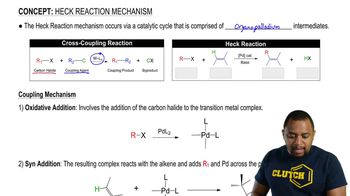
Heck Reaction Mechanism

Stability of Anions

The stability of anions is a key factor in determining the favorability of a reaction. Anions are negatively charged species, and their stability can be influenced by factors such as electronegativity, resonance, and inductive effects. More stable anions are generally formed in reactions that are thermodynamically favorable, leading to a lower energy transition state and a higher equilibrium constant (K_eq).
추천 영상:
가이드 코스
0:53
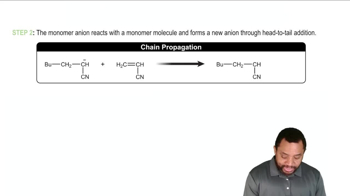
Anionic Polymerization Concept 3

Equilibrium Constant (K_eq)

The equilibrium constant (K_eq) quantifies the ratio of the concentrations of products to reactants at equilibrium for a reversible reaction. A larger K_eq indicates that the products are favored at equilibrium, while a smaller K_eq suggests that reactants are favored. Estimating K_eq based on the stability of anions involves considering how the formation of more stable anions shifts the equilibrium position towards the products.
추천 영상:
02:19
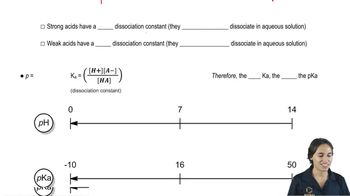
The relationship between equilibrium constant and pKa.