Ch. 6 - Stereoisomerism: Arrangement of Atoms in Space
Mullins - Organic Chemistry: A Learner Centered Approach 1st Edition
Mullins1st EditionOrganic Chemistry: A Learner Centered ApproachISBN: 9780137566471당신이 사용하는 게 아니라요?교과서 변경
5장, 문제 25h

Prioritize the substituents at each chiral center and then, by each of the two methods discussed in Section 6.3.2.4, determine the absolute configuration. [Do not use your models, except to check your answers.]
(h)

검증된 단계별 안내
1
Step 1: Identify the chiral center in the molecule. A chiral center is a carbon atom bonded to four different substituents. In the given structure, the carbon atom attached to CH3, H, O, and the cyclobutane ring is the chiral center.
Step 2: Assign priorities to the substituents based on the Cahn-Ingold-Prelog (CIP) rules. The substituent with the highest atomic number gets the highest priority (1). Here, oxygen (O) has the highest atomic number, so it is priority 1. The cyclobutane ring is next, as the carbon directly attached to the chiral center has a higher atomic number than the hydrogen and methyl group. The methyl group (CH3) is priority 3, and hydrogen (H) is priority 4.
Step 3: Orient the molecule so that the lowest priority group (H) is pointing away from you. This is typically represented by the dashed wedge in the diagram.
Step 4: Determine the order of the remaining substituents (1 → 2 → 3) in a clockwise or counterclockwise direction. If the sequence is clockwise, the configuration is R. If the sequence is counterclockwise, the configuration is S.
Step 5: Verify the configuration using the second method discussed in Section 6.3.2.4, which involves visualizing the molecule in 3D or using a systematic approach to confirm the absolute configuration. Ensure that the priorities and orientation are consistent with the rules.

비슷한 문제에 대한 검증된 영상 답변:

이 영상 해법은 위 문제에 도움이 된다고 튜터들이 추천한 것입니다.

주요 개념

질문에 올바르게 답하기 위해 반드시 이해해야 하는 핵심 개념들은 다음과 같습니다.

Chirality and Chiral Centers

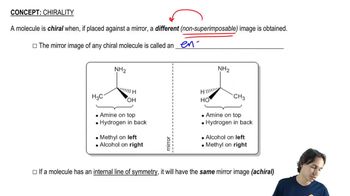
Chirality refers to the geometric property of a molecule having non-superimposable mirror images, known as enantiomers. A chiral center, typically a carbon atom, is bonded to four different substituents, leading to two distinct configurations. Understanding chirality is essential for determining the absolute configuration of molecules, which is crucial in organic chemistry, especially in the context of stereochemistry.
추천 영상:
05:10
What is chirality?

Cahn-Ingold-Prelog Priority Rules

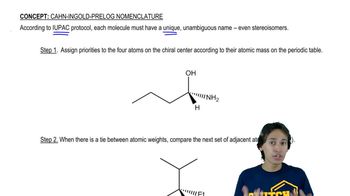
The Cahn-Ingold-Prelog (CIP) priority rules are a set of guidelines used to assign priorities to substituents attached to a chiral center. According to these rules, substituents are ranked based on the atomic number of the atoms directly attached to the chiral center, with higher atomic numbers receiving higher priority. This ranking is fundamental for determining the absolute configuration (R or S) of chiral centers in organic molecules.
추천 영상:
01:48
Why stereoisomers need their own naming system.

Absolute Configuration

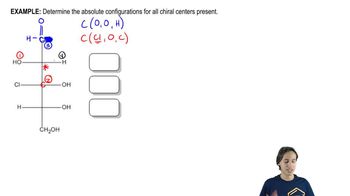
Absolute configuration refers to the specific three-dimensional arrangement of atoms around a chiral center, designated as either R (rectus) or S (sinister) based on the CIP priority rules. To determine the absolute configuration, one must visualize the molecule in three dimensions and apply the priority rankings to ascertain the orientation of the substituents. This concept is vital for understanding the behavior and reactivity of chiral compounds in chemical reactions.
추천 영상:
05:25
Determining Absolute Configurations
관련 실천
교과서 질문

Naproxen is a commercially available anti-inflammatory sold under the name Aleve.

(a) Assign the absolute configuration as R or S.

1548
views

교과서 질문

Prioritize the substituents at each chiral center and then, by each of the two methods discussed in Section 6.3.2.4, determine the absolute configuration. [Do not use your models, except to check your answers.]

(d)

912
views
교과서 질문

Naproxen is a commercially available anti-inflammatory sold under the name Aleve.

(b) Given that naproxen rotates plane-polarized light in the clockwise direction, should it be referred to as (d) or (l)?

(c) Is it (+) or (-)?

(d) What direction (d or l; + or −) would you expect the enantiomer of naproxen to rotate plane-polarized light?

1479
views
교과서 질문

Prioritize the substituents at each chiral center and then, by comparing them to the models you created in Section 6.3.2, label the absolute configuration as R or S

(f)

930
views
교과서 질문

(R)-Limonene is a cyclic terpene responsible for the smell of oranges and other citrus fruits.

(a) Given that (R)-limonene rotates plane-polarized light in the clockwise direction, should it be referred to as (d) or (l)?

(b) Is it (+) or (-)?

(c) What direction (d or l; + or −) would you expect (S)-limonene to rotate plane-polarized light?

1169
views
교과서 질문

Prioritize the substituents at each chiral center and then, by each of the two methods discussed in Section 6.3.2.4, determine the absolute configuration. [Do not use your models, except to check your answers.]

(c)

1405
views