Ch. 6 - Stereoisomerism: Arrangement of Atoms in Space
Mullins - Organic Chemistry: A Learner Centered Approach 1st Edition
Mullins1st EditionOrganic Chemistry: A Learner Centered ApproachISBN: 9780137566471당신이 사용하는 게 아니라요?교과서 변경
5장, 문제 26

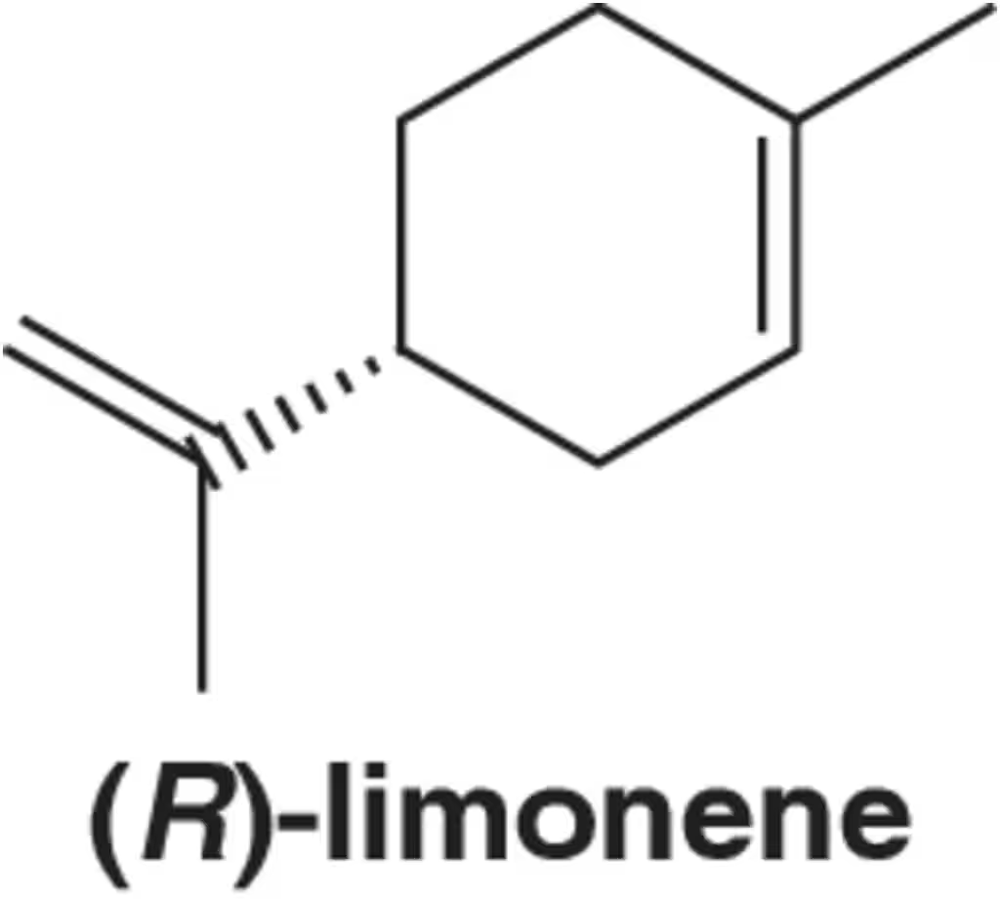
(R)-Limonene is a cyclic terpene responsible for the smell of oranges and other citrus fruits.
(a) Given that (R)-limonene rotates plane-polarized light in the clockwise direction, should it be referred to as (d) or (l)?
(b) Is it (+) or (-)?
(c) What direction (d or l; + or −) would you expect (S)-limonene to rotate plane-polarized light?
Chemical structure of (R)-limonene, a cyclic terpene with a citrus scent, labeled clearly for educational purposes.

검증된 단계별 안내
1
Step 1: Understand the relationship between the (R) and (S) stereochemical designations and the direction of rotation of plane-polarized light. The (R) and (S) designations are based on the Cahn-Ingold-Prelog priority rules and do not directly indicate the direction of optical rotation.
Step 2: Recall that the terms (d) and (l) refer to dextrorotatory and levorotatory, respectively. A compound is dextrorotatory (d) if it rotates plane-polarized light clockwise, and levorotatory (l) if it rotates plane-polarized light counterclockwise. Since (R)-limonene rotates light clockwise, it should be referred to as (d).
Step 3: Understand the relationship between the (+) and (−) notation and optical rotation. The (+) notation corresponds to clockwise rotation (dextrorotatory), while the (−) notation corresponds to counterclockwise rotation (levorotatory). Since (R)-limonene rotates light clockwise, it is also (+).
Step 4: Consider the stereochemical inversion from (R)-limonene to (S)-limonene. The (S)-enantiomer of a chiral compound typically rotates plane-polarized light in the opposite direction to its (R)-enantiomer. Therefore, if (R)-limonene is (d) and (+), (S)-limonene would be (l) and (−).
Step 5: Summarize the findings: (a) (R)-limonene is (d), (b) (R)-limonene is (+), and (c) (S)-limonene is expected to be (l) and (−), as it rotates plane-polarized light in the opposite direction to (R)-limonene.

비슷한 문제에 대한 검증된 영상 답변:

이 영상 해법은 위 문제에 도움이 된다고 튜터들이 추천한 것입니다.

주요 개념

질문에 올바르게 답하기 위해 반드시 이해해야 하는 핵심 개념들은 다음과 같습니다.

Optical Activity

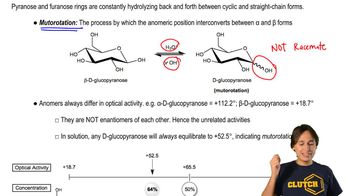
Optical activity refers to the ability of chiral compounds to rotate the plane of polarized light. This property arises from the asymmetry of the molecule, which can exist in two enantiomeric forms that rotate light in opposite directions. The direction of rotation is designated as clockwise (dextrorotatory, +) or counterclockwise (levorotatory, -). Understanding optical activity is crucial for distinguishing between enantiomers.
추천 영상:
08:17
Mutarotation and Optical Activity

Enantiomers and Chirality

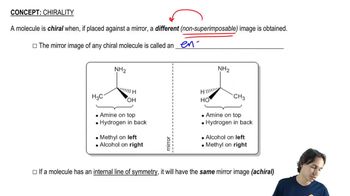
Enantiomers are pairs of molecules that are non-superimposable mirror images of each other, typically due to the presence of a chiral center. Chirality is a key concept in organic chemistry, as it affects the physical and chemical properties of compounds, including their interaction with polarized light. The designation of enantiomers as (R) or (S) is based on the Cahn-Ingold-Prelog priority rules, which help determine their spatial arrangement.
추천 영상:
05:10
What is chirality?

Cahn-Ingold-Prelog System

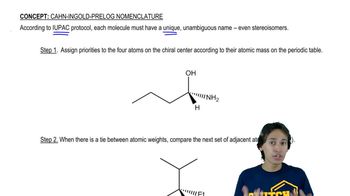
The Cahn-Ingold-Prelog (CIP) system is a set of rules used to assign the configuration of chiral centers in molecules. It involves ranking the substituents attached to the chiral carbon based on atomic number and connectivity. The configuration is designated as (R) for clockwise and (S) for counterclockwise arrangement when viewed from a specific perspective. This system is essential for accurately describing the stereochemistry of organic compounds.
추천 영상:
01:48
Why stereoisomers need their own naming system.