Ch. 9 - Alkenes 2: Oxidation and Reduction
Mullins - Organic Chemistry: A Learner Centered Approach 1st Edition
Mullins1st EditionOrganic Chemistry: A Learner Centered ApproachISBN: 9780137566471당신이 사용하는 게 아니라요?교과서 변경
8장, 문제 26a

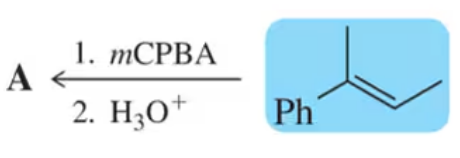
Predict the product(s) of each of the following reactions, making sure to indicate the relative stereochemical outcome. Indicate any racemic mixtures by drawing both enantiomers.
(a) Reaction scheme showing epoxidation with mCPBA and H3O+, indicating product stereochemistry and phenyl group.

검증된 단계별 안내
1
Analyze the reaction conditions and reagents provided. Determine the type of reaction mechanism involved (e.g., substitution, elimination, addition, etc.). For example, if the reaction involves a nucleophile and an alkyl halide, it might proceed via an SN1 or SN2 mechanism.
Identify the starting material's structure, including any stereocenters. If stereochemistry is relevant, note whether the starting material is chiral or achiral.
Predict the intermediate(s) formed during the reaction. For example, in an SN1 reaction, a carbocation intermediate may form, and its stability will influence the reaction pathway.
Determine the final product(s) based on the reaction mechanism. If the reaction generates stereoisomers, indicate whether the product is a single stereoisomer, a diastereomeric mixture, or a racemic mixture. For racemic mixtures, draw both enantiomers.
Verify the stereochemical outcome by considering the reaction's stereospecificity or stereoselectivity. For example, an SN2 reaction inverts the configuration at the stereocenter, while an SN1 reaction may lead to a racemic mixture due to planar carbocation intermediate formation.

비슷한 문제에 대한 검증된 영상 답변:

이 영상 해법은 위 문제에 도움이 된다고 튜터들이 추천한 것입니다.
영상 길이:
6m

주요 개념

질문에 올바르게 답하기 위해 반드시 이해해야 하는 핵심 개념들은 다음과 같습니다.

Reaction Mechanisms

Understanding reaction mechanisms is crucial in organic chemistry as they describe the step-by-step process by which reactants transform into products. This includes identifying intermediates, transition states, and the movement of electrons. Knowledge of mechanisms helps predict the products and their stereochemistry based on the nature of the reactants and the conditions of the reaction.
추천 영상:
02:16
Heck Reaction Mechanism

Stereochemistry

Stereochemistry involves the study of the spatial arrangement of atoms in molecules and how this affects their chemical behavior. It is essential for predicting the relative stereochemical outcomes of reactions, including the formation of chiral centers and the possibility of enantiomers. Understanding concepts like chirality, diastereomers, and racemic mixtures is vital for accurately representing the products of reactions.
추천 영상:
가이드 코스
1:38
Polymer Stereochemistry Concept 1

Functional Groups

Functional groups are specific groups of atoms within molecules that are responsible for the characteristic chemical reactions of those molecules. Recognizing functional groups helps in predicting the reactivity and products of organic reactions. Different functional groups can influence the mechanism and stereochemical outcomes, making it essential to identify them when analyzing reactions.
추천 영상:
02:36
Identifying Functional Groups