Ch. 9 - Alkenes 2: Oxidation and Reduction
Mullins - Organic Chemistry: A Learner Centered Approach 1st Edition
Mullins1st EditionOrganic Chemistry: A Learner Centered ApproachISBN: 9780137566471당신이 사용하는 게 아니라요?교과서 변경
8장, 문제 24

There are two mechanisms by which each of the two enantiomers can form in the reaction shown in Figure 9.37. Show them.
<IMAGE>

검증된 단계별 안내
1
Step 1: The reaction begins with the formation of an epoxide from the alkene. This occurs via the reaction of the alkene with a peracid (persulfonic acid in this case), which transfers an oxygen atom to the double bond, forming a three-membered epoxide ring. This step is stereospecific and retains the stereochemistry of the starting alkene.
Step 2: The epoxide undergoes an acid-base reaction in the presence of the sulfonic acid catalyst. The oxygen in the epoxide ring is protonated, making the ring more electrophilic and susceptible to nucleophilic attack.
Step 3: The protonated epoxide is opened by water, which acts as a nucleophile. The attack can occur at either carbon of the epoxide ring, leading to the formation of two different enantiomers. The stereochemistry of the product depends on the direction of the nucleophilic attack.
Step 4: The resulting intermediate undergoes a second acid-base reaction, where a proton is transferred to regenerate the sulfonic acid catalyst. This step ensures the catalytic cycle continues.
Step 5: The final products are two enantiomers of the diol, formed as a result of the stereospecific opening of the epoxide ring. The persulfonic acid is regenerated in the process, completing the catalytic cycle.

비슷한 문제에 대한 검증된 영상 답변:

이 영상 해법은 위 문제에 도움이 된다고 튜터들이 추천한 것입니다.

주요 개념

질문에 올바르게 답하기 위해 반드시 이해해야 하는 핵심 개념들은 다음과 같습니다.

Enantiomers

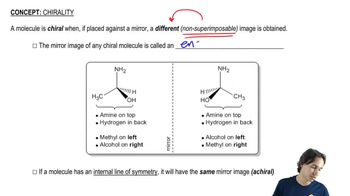
Enantiomers are a type of stereoisomer that are non-superimposable mirror images of each other. They have the same molecular formula and connectivity but differ in the spatial arrangement of atoms. This property is crucial in organic chemistry, especially in reactions involving chiral centers, as enantiomers can exhibit different biological activities and reactivities.
추천 영상:
03:23
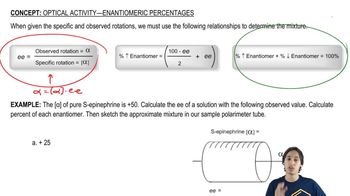
How to solve for the percentage of each enantiomer.

Chirality

Chirality refers to the geometric property of a molecule that makes it non-superimposable on its mirror image. A chiral molecule typically has at least one carbon atom bonded to four different substituents, creating two distinct configurations. Understanding chirality is essential for predicting the formation of enantiomers in chemical reactions, as it influences how molecules interact with other chiral environments.
추천 영상:
05:10
What is chirality?

Reaction Mechanisms

A reaction mechanism is a step-by-step description of the process by which reactants are converted into products. It outlines the sequence of bond-breaking and bond-forming events, including the formation of intermediates and transition states. In the context of enantiomer formation, understanding the mechanism helps in identifying how each enantiomer is produced and the role of stereochemistry in the reaction.
추천 영상:
02:16
Heck Reaction Mechanism