Ch.11 - Reactions of Alcohols
Wade - Organic Chemistry 9th Edition
Wade9th EditionOrganic ChemistryISBN: 9780135213728당신이 사용하는 게 아니라요?교과서 변경
11장, 문제 39c,d

Predict the major products of the following reactions, including stereochemistry where appropriate.
(c) cyclooctanol + NaOCl/HOAC
(d) cyclopentylmethanol + CrO3·pyridine·HCl

검증된 단계별 안내
1
Step 1: Understand the reagents and their roles. For reaction (c), NaOCl (sodium hypochlorite) in the presence of HOAc (acetic acid) is a mild oxidizing agent. It oxidizes primary alcohols to aldehydes and secondary alcohols to ketones. For reaction (d), CrO3・pyridine・HCl (Collins reagent) is a selective oxidizing agent that converts primary alcohols to aldehydes and secondary alcohols to ketones.
Step 2: Analyze the structure of cyclooctanol in reaction (c). Cyclooctanol is a secondary alcohol because the hydroxyl group (-OH) is attached to a carbon atom that is bonded to two other carbon atoms. When treated with NaOCl/HOAc, the secondary alcohol will be oxidized to a ketone. The product will retain the cyclooctane ring structure, with the ketone group replacing the hydroxyl group.
Step 3: Consider stereochemistry for reaction (c). Since the starting material is cyclooctanol, which is a cyclic compound, the stereochemistry of the product will depend on the stereochemistry of the starting alcohol. However, oxidation of a secondary alcohol to a ketone typically results in the loss of stereochemistry at the carbon bearing the hydroxyl group, as the ketone is planar (sp2 hybridized).
Step 4: Analyze the structure of cyclopentylmethanol in reaction (d). Cyclopentylmethanol is a primary alcohol because the hydroxyl group is attached to a carbon atom that is bonded to only one other carbon atom. When treated with CrO3・pyridine・HCl, the primary alcohol will be oxidized to an aldehyde. The product will retain the cyclopentane ring structure, with the aldehyde group replacing the hydroxymethyl group.
Step 5: Summarize the major products. For reaction (c), the major product is cyclooctanone, a ketone. For reaction (d), the major product is cyclopentylmethanal, an aldehyde. Ensure to consider the planar nature of the ketone and aldehyde functional groups when discussing stereochemistry.

비슷한 문제에 대한 검증된 영상 답변:

이 영상 해법은 위 문제에 도움이 된다고 튜터들이 추천한 것입니다.
영상 길이:
4m

주요 개념

질문에 올바르게 답하기 위해 반드시 이해해야 하는 핵심 개념들은 다음과 같습니다.

Oxidation Reactions

Oxidation reactions involve the loss of electrons or an increase in oxidation state by a molecule. In organic chemistry, this often pertains to the conversion of alcohols to carbonyl compounds (aldehydes or ketones) or carboxylic acids. Understanding the specific reagents used, such as CrO3 in the presence of pyridine, is crucial for predicting the products of these reactions.
추천 영상:
03:20
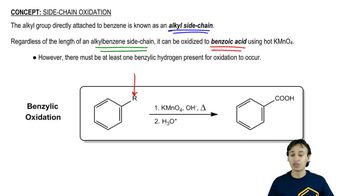
Benzylic Oxidation

Stereochemistry

Stereochemistry refers to the study of the spatial arrangement of atoms in molecules and how this affects their chemical behavior. In reactions involving chiral centers, the stereochemical outcome can be significant, leading to different products based on the configuration of the starting materials. Recognizing stereochemical implications is essential when predicting the major products of reactions.
추천 영상:
가이드 코스
1:38
Polymer Stereochemistry Concept 1

Reagents and Reaction Conditions

The choice of reagents and reaction conditions can greatly influence the outcome of organic reactions. For example, NaOCl in acetic acid (HOAc) is a mild oxidizing agent that can selectively oxidize alcohols, while CrO3 in pyridine is a stronger oxidant that can fully oxidize primary alcohols to carboxylic acids. Understanding how these reagents interact with substrates is key to predicting the products.
추천 영상:
01:52
Reagents