Ch.11 - Reactions of Alcohols
Wade - Organic Chemistry 9th Edition
Wade9th EditionOrganic ChemistryISBN: 9780135213728당신이 사용하는 게 아니라요?교과서 변경
11장, 문제 39a,b

Predict the major products of the following reactions, including stereochemistry where appropriate.
(a) (R)-butan-2-ol + TsCl in pyridine
(b) (S)-2-butyl tosylate + NaBr

검증된 단계별 안내
1
Step 1: Analyze the first reaction (a). The reaction involves (R)-butan-2-ol reacting with tosyl chloride (TsCl) in pyridine. This is a tosylation reaction, where the hydroxyl group (-OH) of the alcohol is converted into a tosylate group (-OTs). The pyridine acts as a base to neutralize the HCl byproduct. The stereochemistry of the carbon center remains unchanged during this step, so the product will be (R)-2-butyl tosylate.
Step 2: Write the chemical equation for reaction (a). The structure of (R)-butan-2-ol is CH₃-CH(OH)-CH₂-CH₃, and the product will be CH₃-CH(OTs)-CH₂-CH₃. The stereochemistry at the chiral center (C2) remains (R).
Step 3: Analyze the second reaction (b). The reaction involves (S)-2-butyl tosylate reacting with NaBr. This is a nucleophilic substitution reaction (SN2 mechanism) because the tosylate group (-OTs) is a good leaving group, and bromide ion (Br⁻) is a strong nucleophile. In an SN2 reaction, the nucleophile attacks the electrophilic carbon from the opposite side of the leaving group, resulting in an inversion of configuration at the chiral center.
Step 4: Write the chemical equation for reaction (b). The structure of (S)-2-butyl tosylate is CH₃-CH(OTs)-CH₂-CH₃. The bromide ion (Br⁻) will replace the tosylate group, forming CH₃-CH(Br)-CH₂-CH₃. Due to the inversion of configuration, the product will have the (R)-configuration at the chiral center.
Step 5: Summarize the major products. For reaction (a), the product is (R)-2-butyl tosylate. For reaction (b), the product is (R)-2-bromobutane. Ensure to include stereochemistry in your final answer, as it is critical for understanding the outcome of these reactions.

비슷한 문제에 대한 검증된 영상 답변:

이 영상 해법은 위 문제에 도움이 된다고 튜터들이 추천한 것입니다.
영상 길이:
3m

주요 개념

질문에 올바르게 답하기 위해 반드시 이해해야 하는 핵심 개념들은 다음과 같습니다.

Tosylation

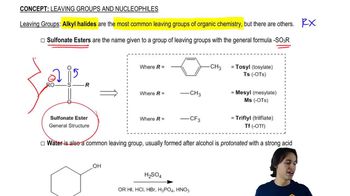
Tosylation is the process of converting an alcohol into a tosylate using tosyl chloride (TsCl) in the presence of a base like pyridine. This reaction transforms the alcohol into a better leaving group, facilitating subsequent nucleophilic substitution reactions. The resulting tosylate retains the stereochemistry of the original alcohol, which is crucial for predicting the products in further reactions.
추천 영상:
07:22
The 3 important leaving groups to know.

Nucleophilic Substitution Reactions

Nucleophilic substitution reactions involve the replacement of a leaving group by a nucleophile. In the case of the reaction between 2-butyl tosylate and NaBr, the bromide ion acts as the nucleophile, attacking the carbon atom bonded to the tosylate group. The mechanism can be either SN1 or SN2, depending on the substrate structure and conditions, which influences the stereochemistry of the product.
추천 영상:
01:47
Nucleophiles and Electrophiles can react in Substitution Reactions.

Stereochemistry

Stereochemistry refers to the spatial arrangement of atoms in molecules and how this affects their chemical behavior. In reactions involving chiral centers, such as those with butan-2-ol and its derivatives, the stereochemistry of the reactants must be considered to predict the stereochemical outcome of the products. Understanding whether a reaction proceeds via an inversion of configuration or retention is essential for accurate product prediction.
추천 영상:
가이드 코스
1:38
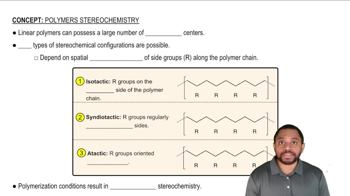
Polymer Stereochemistry Concept 1