Ch.11 - Reactions of Alcohols
Wade - Organic Chemistry 9th Edition
Wade9th EditionOrganic ChemistryISBN: 9780135213728당신이 사용하는 게 아니라요?교과서 변경
11장, 문제 9d,e

Predict the major products of the following reactions.
(d) the tosylate of cyclohexylmethanol + excess NH3
(e) n-butyl tosylate + sodium acetylide, H–C≡C:– +Na

검증된 단계별 안내
1
Step 1: Analyze the reaction in part (d). The tosylate group (-OTs) is a good leaving group, and cyclohexylmethanol tosylate will undergo nucleophilic substitution when reacted with excess NH3. The nucleophile (NH3) will attack the carbon attached to the tosylate group, replacing the tosylate with an amine group (-NH2).
Step 2: For part (d), consider the mechanism. Since NH3 is in excess, the reaction will likely proceed via an SN2 mechanism due to the primary nature of the carbon attached to the tosylate group. This results in inversion of configuration at the carbon center, if it is chiral.
Step 3: Analyze the reaction in part (e). n-Butyl tosylate contains a tosylate group (-OTs) attached to a primary carbon. Sodium acetylide (NaC≡CH) is a strong nucleophile due to the negatively charged acetylide ion. The acetylide ion will attack the carbon attached to the tosylate group, displacing the tosylate via an SN2 mechanism.
Step 4: For part (e), the product will be formed by the substitution of the tosylate group with the acetylide ion (-C≡CH). This results in the formation of a new carbon-carbon bond between the n-butyl group and the acetylide ion.
Step 5: Summarize the major products. For part (d), the major product is cyclohexylmethylamine (cyclohexylmethanol with the -OH group replaced by -NH2). For part (e), the major product is n-butylacetylene (n-butyl group bonded to -C≡CH).

비슷한 문제에 대한 검증된 영상 답변:

이 영상 해법은 위 문제에 도움이 된다고 튜터들이 추천한 것입니다.
영상 길이:
2m

주요 개념

질문에 올바르게 답하기 위해 반드시 이해해야 하는 핵심 개념들은 다음과 같습니다.

Tosylate Formation

Tosylates are derivatives of alcohols formed by reacting alcohols with tosyl chloride (TsCl) in the presence of a base. This reaction converts the hydroxyl group (-OH) into a better leaving group, the tosylate group (-OTs), facilitating nucleophilic substitution reactions. Understanding tosylate formation is crucial for predicting the products of reactions involving alcohols and nucleophiles.
추천 영상:
02:26
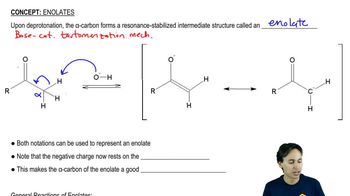
Formation of Enolates

Nucleophilic Substitution Reactions

Nucleophilic substitution reactions involve the replacement of a leaving group in a molecule with a nucleophile. The strength and nature of the nucleophile, as well as the structure of the substrate, influence the reaction pathway (SN1 or SN2). In the given question, ammonia (NH3) acts as a nucleophile, attacking the tosylate to form an amine product.
추천 영상:
01:47
Nucleophiles and Electrophiles can react in Substitution Reactions.

Acetylide Ion Reactivity

The acetylide ion (HC≡C:−) is a strong nucleophile due to its negative charge and sp-hybridized carbon, which makes it highly reactive towards electrophiles. In the reaction with n-butyl tosylate, the acetylide ion can perform a nucleophilic substitution, leading to the formation of a terminal alkyne. Understanding the reactivity of acetylide ions is essential for predicting the outcomes of reactions involving alkyl halides or tosylates.
추천 영상:
가이드 코스
2:18
Metal Ion Catalysis Example 1