Ch.11 - Reactions of Alcohols
Wade - Organic Chemistry 9th Edition
Wade9th EditionOrganic ChemistryISBN: 9780135213728당신이 사용하는 게 아니라요?교과서 변경
11장, 문제 6f

Suggest the most appropriate method for each of the following laboratory syntheses. In each case, suggest both a chromium reagent and a chromium-free reagent.
(f) 1-methylcyclohexanol → 2-methylcyclohexanone (several steps)

검증된 단계별 안내
1
Step 1: Recognize the transformation. The problem involves converting 1-methylcyclohexanol (a secondary alcohol) into 2-methylcyclohexanone (a ketone). This requires oxidation and a shift of the methyl group from position 1 to position 2.
Step 2: Plan the oxidation step. To oxidize the secondary alcohol to a ketone, you can use a chromium-based reagent such as pyridinium chlorochromate (PCC) or Jones reagent (CrO₃ in H₂SO₄). Alternatively, for a chromium-free option, you can use Dess-Martin periodinane (DMP) or Swern oxidation.
Step 3: Consider the methyl group migration. After oxidation, you need to shift the methyl group from position 1 to position 2. This can be achieved through a rearrangement reaction, such as a pinacol rearrangement, which involves acidic conditions to promote the migration.
Step 4: Suggest the chromium-based method. Use PCC or Jones reagent to oxidize 1-methylcyclohexanol to 1-methylcyclohexanone. Then, treat the ketone with an acid catalyst (e.g., H₂SO₄) to induce the methyl group migration, forming 2-methylcyclohexanone.
Step 5: Suggest the chromium-free method. Use Dess-Martin periodinane (DMP) or Swern oxidation to oxidize 1-methylcyclohexanol to 1-methylcyclohexanone. Follow this with the same acid-catalyzed rearrangement to achieve the desired product, 2-methylcyclohexanone.

비슷한 문제에 대한 검증된 영상 답변:

이 영상 해법은 위 문제에 도움이 된다고 튜터들이 추천한 것입니다.
영상 길이:
7m

주요 개념

질문에 올바르게 답하기 위해 반드시 이해해야 하는 핵심 개념들은 다음과 같습니다.

Oxidation Reactions

Oxidation reactions involve the loss of electrons or an increase in oxidation state by a molecule. In organic chemistry, these reactions are crucial for converting alcohols into carbonyl compounds, such as ketones. Understanding the mechanisms of oxidation helps in selecting appropriate reagents for synthesizing compounds like 2-methylcyclohexanone from 1-methylcyclohexanol.
추천 영상:
03:20
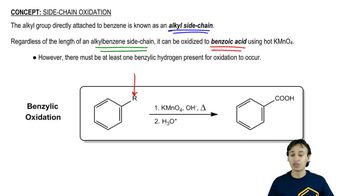
Benzylic Oxidation

Chromium Reagents

Chromium reagents, such as chromium trioxide (CrO3) or pyridinium chlorochromate (PCC), are commonly used in organic synthesis for the oxidation of alcohols to carbonyl compounds. These reagents are effective but can be toxic and environmentally hazardous, necessitating careful handling and disposal. Knowledge of their reactivity and selectivity is essential for proposing suitable methods in laboratory syntheses.
추천 영상:
06:50
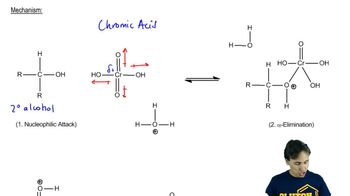
Jones Reagent Mechanism

Alternative Oxidation Methods

Chromium-free oxidation methods, such as using Dess-Martin periodinane or Swern oxidation, provide safer and more environmentally friendly alternatives for converting alcohols to ketones. These methods often have milder reaction conditions and fewer toxic byproducts, making them attractive options in organic synthesis. Familiarity with these alternatives is important for suggesting diverse synthetic pathways.
추천 영상:
가이드 코스
1:24
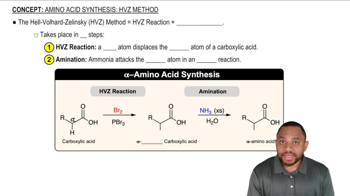
Amino Acid Synthesis: HVZ Method Concept 1