

Ch. 15 - Conjugated Systems, Orbital Symmetry, and Ultraviolet Spectroscopy
Wade - Organic Chemistry 9th Edition
Wade9th EditionOrganic ChemistryISBN: 9780135213728당신이 사용하는 게 아니라요?교과서 변경
15장, 문제 37b,c,d

The pentadienyl radical, H2C=CH–CH=CH–CH2•, has its unpaired electron delocalized over three carbon atoms.
b. How many MOs are there in the molecular orbital picture of the pentadienyl radical?
c. How many nodes are there in the lowest-energy MO of the pentadienyl system? How many in the highest-energy MO?
d. Draw the MOs of the pentadienyl system in order of increasing energy

검증된 단계별 안내
1
Step 1: Understand the molecular orbital (MO) theory for conjugated systems. The pentadienyl radical has a conjugated π-system with five carbon atoms, where the unpaired electron is delocalized over three carbons. The number of molecular orbitals corresponds to the number of atomic p orbitals involved in the conjugation. Since there are five carbon atoms, there are five p orbitals contributing to the π-system, resulting in five molecular orbitals.
Step 2: Determine the number of nodes in the molecular orbitals. Nodes are regions where the electron density is zero. The lowest-energy MO has no nodes, as it is completely bonding. The highest-energy MO has the maximum number of nodes, which is equal to the number of contributing p orbitals minus one. For the pentadienyl radical, the highest-energy MO will have 4 nodes.
Step 3: Visualize the molecular orbitals in order of increasing energy. Start with the lowest-energy MO, which has all p orbitals in phase (no nodes). As energy increases, nodes are introduced progressively, with alternating bonding and antibonding interactions. The highest-energy MO will have all p orbitals out of phase, creating 4 nodes.
Step 4: Draw the molecular orbitals. Represent the five molecular orbitals graphically, showing the phase of the p orbitals and the number of nodes. Label each MO with its energy level and indicate bonding, non-bonding, or antibonding character.
Step 5: Summarize the key points. The pentadienyl radical has five molecular orbitals due to the five contributing p orbitals. The lowest-energy MO has no nodes, while the highest-energy MO has 4 nodes. The molecular orbitals can be drawn in order of increasing energy, showing the progressive introduction of nodes and changes in bonding character.

비슷한 문제에 대한 검증된 영상 답변:

이 영상 해법은 위 문제에 도움이 된다고 튜터들이 추천한 것입니다.
영상 길이:
4m

주요 개념

질문에 올바르게 답하기 위해 반드시 이해해야 하는 핵심 개념들은 다음과 같습니다.

Molecular Orbitals (MOs)

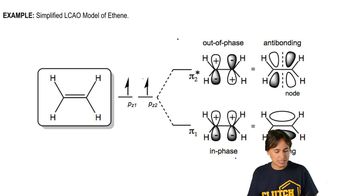
Molecular orbitals are formed by the linear combination of atomic orbitals (LCAO) and describe the behavior of electrons in a molecule. In the case of the pentadienyl radical, the MOs arise from the overlap of p orbitals on adjacent carbon atoms, allowing for the delocalization of the unpaired electron. The number of MOs corresponds to the number of atomic orbitals combined, which is crucial for understanding the electronic structure of the molecule.
추천 영상:
08:41
Review of Molecular Orbitals

Nodes in Molecular Orbitals

Nodes are regions in a molecular orbital where the probability of finding an electron is zero. The number of nodes in a molecular orbital is related to its energy level; lower-energy MOs have fewer nodes, while higher-energy MOs have more. For the pentadienyl radical, analyzing the nodes in the lowest and highest energy MOs helps in understanding the stability and reactivity of the radical.
추천 영상:
08:41
Review of Molecular Orbitals

Delocalization of Electrons

Delocalization refers to the spreading of an electron's presence over multiple atoms rather than being confined to a single bond or atom. In the pentadienyl radical, the unpaired electron is delocalized over three carbon atoms, which stabilizes the radical and influences its reactivity. This concept is essential for predicting the behavior of conjugated systems and understanding their electronic properties.
추천 영상:
03:54
The 18 and 16 Electron Rule