Ch. 17 - Reactions of Aromatic Compounds
Wade - Organic Chemistry 9th Edition
Wade9th EditionOrganic ChemistryISBN: 9780135213728당신이 사용하는 게 아니라요?교과서 변경
17장, 문제 19a

Show how you would synthesize the following aromatic derivatives from benzene.
a. p-tert-butylnitrobenzene

검증된 단계별 안내
1
Step 1: Begin with benzene as the starting material. Benzene is an aromatic compound with a planar ring structure and alternating double bonds.
Step 2: Introduce the tert-butyl group onto the benzene ring through Friedel-Crafts alkylation. Use tert-butyl chloride (C(CH₃)₃Cl) as the alkylating agent and aluminum chloride (AlCl₃) as the catalyst. This reaction will yield tert-butylbenzene.
Step 3: Nitrate the tert-butylbenzene to introduce the nitro group (-NO₂). Perform an electrophilic aromatic substitution reaction using a nitrating mixture of concentrated sulfuric acid (H₂SO₄) and concentrated nitric acid (HNO₃). This reaction will add the nitro group to the para position relative to the tert-butyl group due to steric hindrance and electronic effects.
Step 4: Carefully control the reaction conditions to ensure selective nitration at the para position. The tert-butyl group is an electron-donating group, which directs the incoming nitro group to the para position.
Step 5: Purify the product, p-tert-butylnitrobenzene, using techniques such as recrystallization or chromatography to isolate the desired compound from any side products or unreacted starting materials.

비슷한 문제에 대한 검증된 영상 답변:

이 영상 해법은 위 문제에 도움이 된다고 튜터들이 추천한 것입니다.
영상 길이:
6m

주요 개념

질문에 올바르게 답하기 위해 반드시 이해해야 하는 핵심 개념들은 다음과 같습니다.

Electrophilic Aromatic Substitution (EAS)

Electrophilic Aromatic Substitution is a fundamental reaction in organic chemistry where an electrophile replaces a hydrogen atom on an aromatic ring. This process is crucial for synthesizing various aromatic compounds, as it allows for the introduction of different functional groups onto the benzene ring. Understanding the mechanism of EAS, including the role of catalysts and the stability of intermediates, is essential for predicting the outcomes of reactions involving aromatic compounds.
추천 영상:
03:07
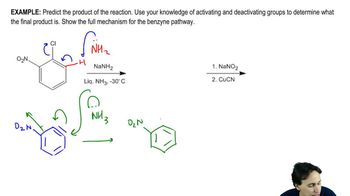
EAS Review

Activating and Deactivating Groups

In the context of EAS, substituents on the aromatic ring can either activate or deactivate the ring towards further substitution. Activating groups, such as alkyl groups, increase the electron density of the ring, making it more reactive towards electrophiles. Conversely, deactivating groups, like nitro groups, withdraw electron density and make the ring less reactive. Recognizing how these groups influence the position and rate of substitution is vital for successful synthesis.
추천 영상:
03:27
Activating and deactivating groups

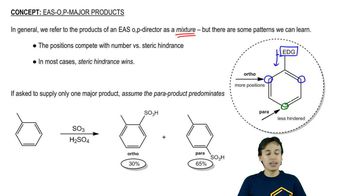
Ortho/Para vs. Meta Directing Effects

The directing effects of substituents on an aromatic ring determine where new substituents will be added during EAS. Ortho and para directing groups favor substitution at the 2 and 4 positions relative to themselves, while meta directing groups favor substitution at the 3 position. Understanding these patterns is essential for predicting the structure of the final product, such as p-tert-butylnitrobenzene, and for planning the synthetic route effectively.
추천 영상:
04:42
Ortho, Para major products