Ch. 17 - Reactions of Aromatic Compounds
Wade - Organic Chemistry 9th Edition
Wade9th EditionOrganic ChemistryISBN: 9780135213728당신이 사용하는 게 아니라요?교과서 변경
17장, 문제 19b

Show how you would synthesize the following aromatic derivatives from benzene.
b. p-toluenesulfonic acid

검증된 단계별 안내
1
Step 1: Begin with benzene (C₆H₆) as the starting material. The goal is to introduce a methyl group (CH₃) and a sulfonic acid group (SO₃H) in the para position relative to each other.
Step 2: Perform a Friedel-Crafts alkylation reaction to introduce the methyl group. React benzene with methyl chloride (CH₃Cl) in the presence of a Lewis acid catalyst, such as aluminum chloride (AlCl₃). This will yield toluene (methylbenzene).
Step 3: Next, perform a sulfonation reaction on toluene. React toluene with concentrated sulfuric acid (H₂SO₄) or fuming sulfuric acid (H₂SO₄ with SO₃). This introduces the sulfonic acid group (SO₃H) onto the aromatic ring.
Step 4: Ensure that the sulfonation occurs at the para position relative to the methyl group. The methyl group is an electron-donating group, which activates the aromatic ring and directs electrophilic substitution to the ortho and para positions. The para product is favored due to steric hindrance at the ortho positions.
Step 5: Isolate and purify the p-toluenesulfonic acid product. This can be done using techniques such as recrystallization or other purification methods to separate it from any minor ortho isomer or unreacted starting materials.

비슷한 문제에 대한 검증된 영상 답변:

이 영상 해법은 위 문제에 도움이 된다고 튜터들이 추천한 것입니다.
영상 길이:
3m

주요 개념

질문에 올바르게 답하기 위해 반드시 이해해야 하는 핵심 개념들은 다음과 같습니다.

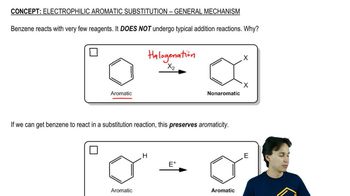
Electrophilic Aromatic Substitution (EAS)

Electrophilic Aromatic Substitution is a fundamental reaction in organic chemistry where an electrophile replaces a hydrogen atom on an aromatic ring. This process is crucial for synthesizing various aromatic derivatives, as it allows for the introduction of different functional groups onto the benzene ring. Understanding the mechanism of EAS, including the role of the electrophile and the stability of the intermediate carbocation, is essential for predicting the products of such reactions.
추천 영상:
03:07
EAS Review

Sulfonation

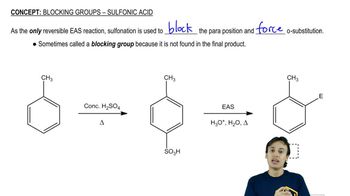
Sulfonation is a specific type of electrophilic aromatic substitution where a sulfonyl group (–SO3H) is introduced into an aromatic compound. In the case of synthesizing p-toluenesulfonic acid from benzene, sulfur trioxide (SO3) or a sulfonating agent like fuming sulfuric acid is used. This reaction typically occurs at the para position relative to existing substituents due to steric and electronic effects, making it a key step in the synthesis of sulfonic acids.
추천 영상:
04:33
Forcing Ortho substitution

Reactivity of Aromatic Compounds

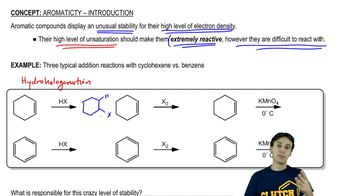
The reactivity of aromatic compounds is influenced by the presence of substituents on the benzene ring, which can either activate or deactivate the ring towards electrophilic substitution. Electron-donating groups, such as methyl (–CH3) in toluene, increase the electron density of the ring, making it more reactive towards electrophiles. Conversely, electron-withdrawing groups decrease reactivity. Understanding these effects is vital for predicting the outcome of reactions and the positions where new substituents will be added.
추천 영상:
08:19
Intro to Aromaticity