Ch. 18 - Ketones and Aldehydes
Wade - Organic Chemistry 9th Edition
Wade9th EditionOrganic ChemistryISBN: 9780135213728당신이 사용하는 게 아니라요?교과서 변경
18장, 문제 29d

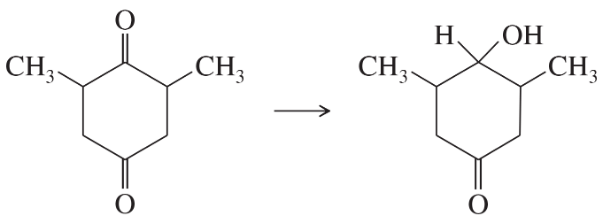
Show how you would accomplish the following syntheses. You may use whatever additional reagents you need.
(d)

검증된 단계별 안내
1
Step 1: Analyze the transformation. The starting material is a diketone with two methyl groups on a cyclohexane ring. The product introduces a hydroxyl group (-OH) and a hydrogen (-H) at the alpha position relative to one of the ketones. This suggests an aldol addition reaction.
Step 2: Identify the reagents needed for the aldol addition. Use a base such as NaOH or KOH to deprotonate the alpha hydrogen of one of the ketones, forming an enolate ion. The enolate will act as a nucleophile.
Step 3: Allow the enolate to attack the carbonyl carbon of the other ketone within the same molecule. This intramolecular reaction forms a new C-C bond and generates a beta-hydroxy ketone intermediate.
Step 4: Neutralize the reaction mixture to stabilize the beta-hydroxy ketone product. This step ensures the hydroxyl group remains intact and prevents further reactions such as dehydration.
Step 5: Confirm the stereochemistry of the product. The hydroxyl group and hydrogen are added to the alpha position, and the stereochemistry is determined by the reaction conditions and the structure of the starting material.

비슷한 문제에 대한 검증된 영상 답변:

이 영상 해법은 위 문제에 도움이 된다고 튜터들이 추천한 것입니다.
영상 길이:
6m

주요 개념

질문에 올바르게 답하기 위해 반드시 이해해야 하는 핵심 개념들은 다음과 같습니다.

Reaction Mechanisms

Understanding reaction mechanisms is crucial in organic chemistry as it describes the step-by-step process by which reactants transform into products. This includes identifying intermediates, transition states, and the types of bonds formed or broken. A clear grasp of mechanisms helps predict the outcome of reactions and the conditions required for successful synthesis.
추천 영상:
02:16
Heck Reaction Mechanism

Functional Groups

Functional groups are specific groups of atoms within molecules that are responsible for the characteristic chemical reactions of those molecules. Recognizing functional groups is essential for predicting reactivity and understanding how different reagents will interact during a synthesis. This knowledge allows chemists to design pathways for creating desired compounds effectively.
추천 영상:
02:36
Identifying Functional Groups

Reagents and Conditions

The choice of reagents and reaction conditions is fundamental in organic synthesis. Different reagents can facilitate specific transformations, while conditions such as temperature, pressure, and solvent can influence reaction rates and selectivity. Understanding how to select and optimize these factors is key to successfully carrying out a synthesis and achieving the desired product.
추천 영상:
01:52
Reagents