Ch. 18 - Ketones and Aldehydes
Wade - Organic Chemistry 9th Edition
Wade9th EditionOrganic ChemistryISBN: 9780135213728당신이 사용하는 게 아니라요?교과서 변경
18장, 문제 29b

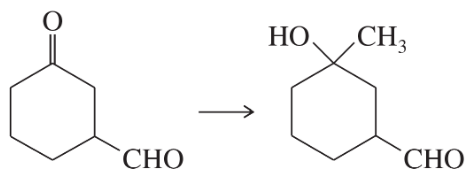
Show how you would accomplish the following syntheses. You may use whatever additional reagents you need.
(b)

검증된 단계별 안내
1
Step 1: Analyze the starting material and the product. The starting material is a cyclohexane ring with a ketone group and an aldehyde group. The product has a cyclohexane ring with an alcohol group, a methyl group, and an aldehyde group. This indicates that the ketone group is converted into a tertiary alcohol, and a methyl group is added.
Step 2: To convert the ketone group into a tertiary alcohol, perform a nucleophilic addition reaction using a Grignard reagent. Prepare the Grignard reagent, CH3MgBr, which will add a methyl group to the ketone carbon.
Step 3: React the starting material with the Grignard reagent (CH3MgBr) in an ether solvent. This will result in the formation of a tertiary alcohol at the ketone position, with the methyl group added.
Step 4: After the Grignard reaction, perform an acidic workup (e.g., using H3O+) to protonate the alkoxide intermediate and yield the final tertiary alcohol product.
Step 5: Verify that the aldehyde group remains intact throughout the reaction sequence, as it is not reactive under the conditions used for the Grignard reaction.

비슷한 문제에 대한 검증된 영상 답변:

이 영상 해법은 위 문제에 도움이 된다고 튜터들이 추천한 것입니다.
영상 길이:
6m

주요 개념

질문에 올바르게 답하기 위해 반드시 이해해야 하는 핵심 개념들은 다음과 같습니다.

Organic Synthesis

Organic synthesis is the process of constructing organic compounds through chemical reactions. It involves the strategic selection of starting materials and reagents to achieve a desired product. Understanding the principles of synthesis is crucial for designing pathways that efficiently convert reactants into target molecules while considering factors like yield and selectivity.
추천 영상:
가이드 코스
1:16
Synthesis of Amino Acids: Strecker Synthesis Example 1

Reaction Mechanisms

A reaction mechanism describes the step-by-step sequence of elementary reactions that occur during a chemical transformation. It provides insight into how bonds are broken and formed, helping predict the products of a reaction. Familiarity with common mechanisms, such as nucleophilic substitution or electrophilic addition, is essential for planning syntheses and understanding the behavior of reagents.
추천 영상:
02:16
Heck Reaction Mechanism

Reagents and Conditions

The choice of reagents and reaction conditions significantly influences the outcome of a synthesis. Reagents can include acids, bases, catalysts, and solvents, each affecting the reaction's rate and selectivity. Understanding how different conditions, such as temperature and pressure, impact reactions is vital for optimizing synthetic routes and achieving desired products.
추천 영상:
01:52
Reagents