Ch. 22 - Condensations and Alpha Substitutions of Carbonyl Compounds
Wade - Organic Chemistry 9th Edition
Wade9th EditionOrganic ChemistryISBN: 9780135213728당신이 사용하는 게 아니라요?교과서 변경
22장, 문제 61(2)

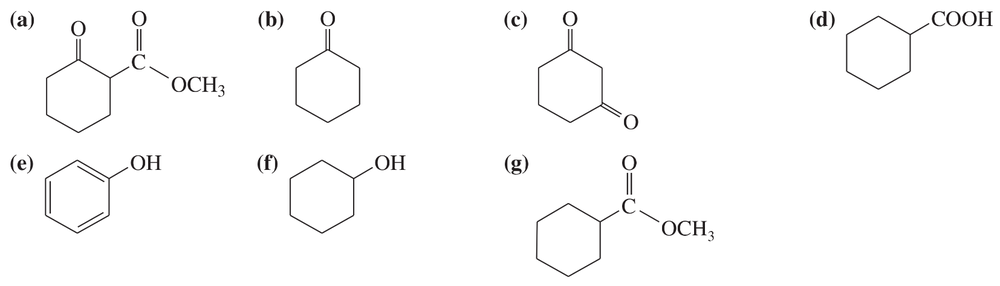
2. Indicate which compounds would be more than 99% deprotonated by a solution of sodium ethoxide in ethanol.

검증된 단계별 안내
1
Step 1: Understand the problem. Sodium ethoxide in ethanol is a strong base, and it will deprotonate compounds with acidic protons. The acidity of a proton is determined by the stability of the conjugate base formed after deprotonation. Look for functional groups such as carboxylic acids, phenols, and alpha-hydrogens adjacent to carbonyl groups.
Step 2: Analyze each compound. For compound I, it contains alpha-hydrogens adjacent to two carbonyl groups. These hydrogens are acidic due to resonance stabilization of the enolate ion formed after deprotonation.
Step 3: For compound II, it has alpha-hydrogens adjacent to a single carbonyl group. These hydrogens are less acidic compared to compound I but can still be deprotonated by sodium ethoxide.
Step 4: For compound IV, it contains a carboxylic acid group. The proton on the hydroxyl group of the carboxylic acid is highly acidic and will be deprotonated by sodium ethoxide.
Step 5: For compound V, it contains a phenol group. The hydroxyl proton is acidic due to resonance stabilization of the phenoxide ion formed after deprotonation. This proton will also be deprotonated by sodium ethoxide.

비슷한 문제에 대한 검증된 영상 답변:

이 영상 해법은 위 문제에 도움이 된다고 튜터들이 추천한 것입니다.
영상 길이:
7m

주요 개념

질문에 올바르게 답하기 위해 반드시 이해해야 하는 핵심 개념들은 다음과 같습니다.

Deprotonation

Deprotonation is the removal of a proton (H+) from a molecule, resulting in the formation of a conjugate base. This process is crucial in organic chemistry, particularly in reactions involving acids and bases. The strength of the base used for deprotonation, such as sodium ethoxide, determines which compounds will be effectively deprotonated. Compounds with acidic protons, such as those adjacent to electronegative atoms or in resonance-stabilized structures, are more likely to undergo deprotonation.
추천 영상:
가이드 코스
4:30
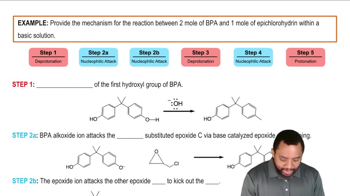
Step-Growth Polymers: Epoxy Resin Example 1

Acidity and pKa

Acidity is a measure of how easily a compound can donate a proton, quantified by its pKa value. Lower pKa values indicate stronger acids, which are more likely to be deprotonated in the presence of a strong base like sodium ethoxide. Understanding the pKa of the compounds in the question is essential for predicting which will be more than 99% deprotonated. Compounds with functional groups such as carboxylic acids or phenols typically have lower pKa values and are more acidic.
추천 영상:
07:45
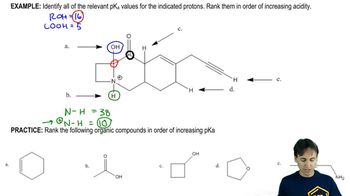
Identifying pKa values

Resonance Stabilization

Resonance stabilization occurs when a molecule can be represented by multiple valid Lewis structures, allowing for the delocalization of electrons. This delocalization can stabilize the negative charge that results from deprotonation, making the conjugate base more stable. Compounds that can stabilize the negative charge through resonance are more likely to be deprotonated by a strong base. Identifying resonance structures in the given compounds will help determine their likelihood of deprotonation.
추천 영상:
03:43
The radical stability trend.