Ch. 22 - Condensations and Alpha Substitutions of Carbonyl Compounds
Wade - Organic Chemistry 9th Edition
Wade9th EditionOrganic ChemistryISBN: 9780135213728당신이 사용하는 게 아니라요?교과서 변경
22장, 문제 60d

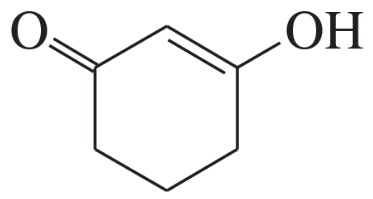
For each molecule shown below,
1. indicate the most acidic hydrogens.
2. draw the important resonance contributors of the anion that results from removal of the most acidic hydrogen.
(d)

검증된 단계별 안내
1
Step 1: Identify the functional groups in the molecule. The molecule contains a ketone group (C=O) and an alcohol group (-OH). These groups influence the acidity of the hydrogens in the molecule.
Step 2: Determine the most acidic hydrogen. The hydrogen attached to the hydroxyl group (-OH) is the most acidic because the resulting anion (after deprotonation) can be stabilized by resonance with the adjacent ketone group.
Step 3: Remove the most acidic hydrogen to form the conjugate base. This involves deprotonating the hydroxyl group (-OH), leaving behind an oxygen atom with a negative charge.
Step 4: Draw the resonance contributors of the anion. The negative charge on the oxygen can delocalize into the carbonyl group (C=O), forming resonance structures. Use curved arrows to show the movement of electrons and draw the resulting resonance forms.
Step 5: Verify the stability of the resonance contributors. Resonance structures that distribute the negative charge over multiple atoms, especially electronegative atoms like oxygen, contribute to the stability of the anion.

비슷한 문제에 대한 검증된 영상 답변:

이 영상 해법은 위 문제에 도움이 된다고 튜터들이 추천한 것입니다.
영상 길이:
3m

주요 개념

질문에 올바르게 답하기 위해 반드시 이해해야 하는 핵심 개념들은 다음과 같습니다.

Acidity of Hydrogens

In organic chemistry, the acidity of a hydrogen atom is determined by its ability to be removed as a proton (H+). Factors influencing acidity include the electronegativity of the atom to which the hydrogen is attached, the stability of the resulting anion, and the presence of electron-withdrawing groups. In the provided molecule, the hydroxyl (–OH) group is typically associated with acidic hydrogen due to its ability to stabilize the resulting anion through resonance.
추천 영상:
00:48
The definition of hydrogenation.

Resonance Structures

Resonance structures are different ways of drawing a molecule that represent the same compound, highlighting the delocalization of electrons. In the context of the anion formed after deprotonation, resonance contributors show how the negative charge can be distributed across multiple atoms, enhancing the stability of the anion. This concept is crucial for predicting the behavior of acids and bases in organic reactions.
추천 영상:
03:04
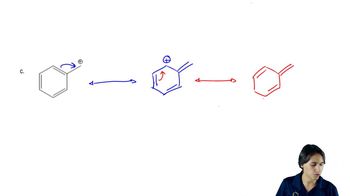
Drawing Resonance Structures

Anion Stability

The stability of an anion is a key factor in determining the acidity of a compound. Anions that can delocalize their negative charge through resonance or are stabilized by electronegative atoms are generally more stable. In the case of the molecule in question, the anion formed after removing the most acidic hydrogen can be stabilized by resonance with the adjacent carbonyl group, making the original hydrogen more acidic.
추천 영상:
가이드 코스
0:53
Anionic Polymerization Concept 3