
Ch. 22 - Condensations and Alpha Substitutions of Carbonyl Compounds
Wade - Organic Chemistry 9th Edition
Wade9th EditionOrganic ChemistryISBN: 9780135213728당신이 사용하는 게 아니라요?교과서 변경
22장, 문제 55a

Propose a mechanism for the conjugate addition of a nucleophile (Nuc:–) to acrylonitrile (H2C=CHCN). Use resonance forms to show how the cyano activate the double bond toward conjugate addition.

검증된 단계별 안내
1
Step 1: Begin by identifying the structure of acrylonitrile (H₂C=CHCN). Acrylonitrile contains a double bond (C=C) conjugated with a cyano group (-CN). The cyano group is an electron-withdrawing group, which stabilizes the intermediate formed during the conjugate addition reaction.
Step 2: Use resonance structures to show how the cyano group activates the double bond. Draw the resonance forms of acrylonitrile, where the electron density from the π-bond of the double bond shifts toward the cyano group. This creates a partial positive charge on the β-carbon (the carbon adjacent to the cyano group) and a partial negative charge on the cyano group.
Step 3: Introduce the nucleophile (Nuc:-). The nucleophile attacks the β-carbon of the double bond in a conjugate addition reaction. This occurs because the β-carbon is electrophilic due to the electron-withdrawing effect of the cyano group.
Step 4: Show the formation of the intermediate. After the nucleophile attacks the β-carbon, the π-electrons of the double bond shift to the α-carbon (the carbon directly bonded to the cyano group), creating a carbanion intermediate. Represent this intermediate with resonance forms to show how the negative charge is delocalized and stabilized by the cyano group.
Step 5: Conclude the mechanism by protonating the carbanion intermediate (if necessary) to form the final product. The nucleophile is now covalently bonded to the β-carbon, and the cyano group remains attached to the α-carbon, completing the conjugate addition reaction.

비슷한 문제에 대한 검증된 영상 답변:

이 영상 해법은 위 문제에 도움이 된다고 튜터들이 추천한 것입니다.
영상 길이:
3m

주요 개념

질문에 올바르게 답하기 위해 반드시 이해해야 하는 핵심 개념들은 다음과 같습니다.

Conjugate Addition

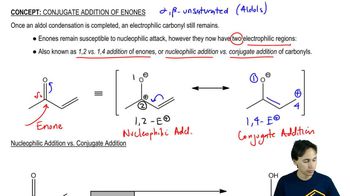
Conjugate addition refers to the nucleophilic attack on an α,β-unsaturated carbonyl compound, where the nucleophile adds to the β-carbon instead of the carbonyl carbon. This process is significant in organic synthesis as it allows for the formation of new carbon-carbon bonds. The stability of the resulting enolate or resonance-stabilized intermediate is a key factor in driving this reaction.
추천 영상:
09:23
1,2 vs 1,4 Addition

Resonance and Electron Delocalization

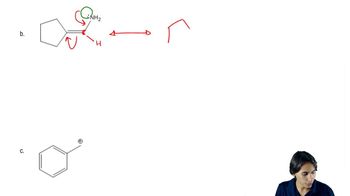
Resonance is a concept in organic chemistry that describes the delocalization of electrons within a molecule, allowing for multiple valid Lewis structures. In the case of acrylonitrile, the cyano group (-CN) can stabilize the double bond through resonance, making the β-carbon more electrophilic and susceptible to nucleophilic attack. This delocalization enhances the reactivity of the double bond in conjugate addition reactions.
추천 영상:
03:32
Drawing Resonance Structures

Nucleophiles

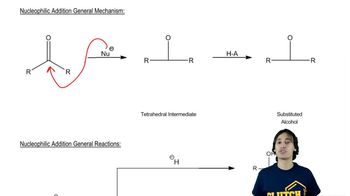
Nucleophiles are species that donate an electron pair to form a chemical bond in a reaction. They are typically negatively charged or neutral molecules with lone pairs of electrons. In the context of the conjugate addition to acrylonitrile, the nucleophile (Nuc:-) attacks the electrophilic β-carbon, facilitated by the resonance effects of the cyano group, leading to the formation of a new bond.
추천 영상:
08:27
Nucleophilic Addition