Ch. 22 - Condensations and Alpha Substitutions of Carbonyl Compounds
Wade - Organic Chemistry 9th Edition
Wade9th EditionOrganic ChemistryISBN: 9780135213728당신이 사용하는 게 아니라요?교과서 변경
22장, 문제 52

In Solved Problem 22-9, the target molecule was synthesized using a Michael addition to form the bond that is β,γ to the upper carbonyl group. Another approach is to use a Michael addition to form the bond that is β,γ to the other (lower) carbonyl group. Show how you would accomplish this alternative synthesis.

검증된 단계별 안내
1
Identify the target molecule and analyze its structure to determine the β,γ bond that needs to be formed relative to the lower carbonyl group. This will help in planning the Michael addition reaction.
Choose an appropriate Michael donor (nucleophile) and Michael acceptor (electrophile). The Michael donor should be an enolate or a compound capable of forming an enolate, while the Michael acceptor should contain an α,β-unsaturated carbonyl group.
Generate the enolate ion from the Michael donor by treating it with a suitable base, such as hydroxide (OH⁻) or an alkoxide (RO⁻). This step activates the donor for nucleophilic attack.
Perform the Michael addition reaction by allowing the enolate ion to attack the β-carbon of the α,β-unsaturated carbonyl compound (Michael acceptor). This forms a new C-C bond at the β,γ position relative to the lower carbonyl group.
After the Michael addition, perform any necessary workup steps, such as protonation of the intermediate, to obtain the final product. Verify that the product matches the target molecule with the desired β,γ bond formed relative to the lower carbonyl group.

비슷한 문제에 대한 검증된 영상 답변:

이 영상 해법은 위 문제에 도움이 된다고 튜터들이 추천한 것입니다.
영상 길이:
4m

주요 개념

질문에 올바르게 답하기 위해 반드시 이해해야 하는 핵심 개념들은 다음과 같습니다.

Michael Addition

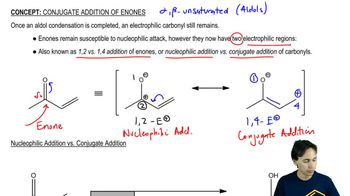
Michael addition is a nucleophilic addition reaction where a nucleophile adds to an α,β-unsaturated carbonyl compound. This reaction typically involves the addition of a carbanion or another nucleophile to the β-carbon of the unsaturated system, resulting in the formation of a new carbon-carbon bond. Understanding this mechanism is crucial for manipulating the position of the bond formed in the synthesis of complex molecules.
추천 영상:
09:23
1,2 vs 1,4 Addition

Carbonyl Chemistry

Carbonyl compounds, characterized by the presence of a carbon-oxygen double bond (C=O), play a significant role in organic synthesis. The reactivity of carbonyl groups allows for various transformations, including nucleophilic additions and condensations. In the context of the question, recognizing the role of the carbonyl groups in directing the Michael addition is essential for planning the alternative synthesis pathway.
추천 영상:
04:20
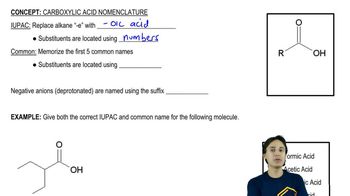
Carboxylic Acids Nomenclature

Stereochemistry

Stereochemistry refers to the study of the spatial arrangement of atoms in molecules and how this affects their chemical behavior. In reactions like the Michael addition, the stereochemical outcome can influence the properties of the final product. Understanding stereochemistry is vital when considering alternative synthesis routes, as it can determine the selectivity and yield of the desired compound.
추천 영상:
가이드 코스
1:38
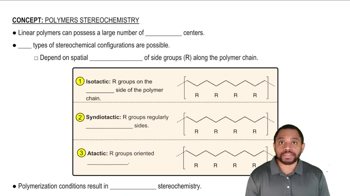
Polymer Stereochemistry Concept 1