Ch. 22 - Condensations and Alpha Substitutions of Carbonyl Compounds
Wade - Organic Chemistry 9th Edition
Wade9th EditionOrganic ChemistryISBN: 9780135213728당신이 사용하는 게 아니라요?교과서 변경
22장, 문제 30

Show how octane-2,7-dione might cyclize to a cycloheptenone. Explain why ring closure to the cycloheptenone is not favored.

검증된 단계별 안내
1
Step 1: Begin by identifying the functional groups in octane-2,7-dione. This molecule contains two ketone groups located at positions 2 and 7 on the octane chain. These ketones can participate in intramolecular aldol condensation, which is a common mechanism for cyclization.
Step 2: Analyze the mechanism for cyclization. The first step involves the enolate formation at one of the ketone groups. The ketone at position 2 can form an enolate ion by deprotonation of the alpha-hydrogen using a base. Represent this enolate formation using the formula: CH3-CO2-CH2-CH2-CH2-CO7-CH3.
Step 3: The enolate ion formed at position 2 can attack the carbonyl carbon of the ketone at position 7. This nucleophilic attack leads to the formation of a new C-C bond, resulting in a seven-membered ring intermediate. Represent the cyclization step using curved arrows to show the movement of electrons.
Step 4: After the ring closure, the intermediate undergoes protonation and dehydration to form the final product, cycloheptenone. The dehydration step involves the elimination of water, which creates the double bond in the cycloheptenone structure. Represent the final structure as: Cycloheptenone.
Step 5: Explain why the ring closure to cycloheptenone is not favored. Seven-membered rings are less stable due to increased ring strain compared to six-membered rings. Additionally, the transition state for forming a seven-membered ring is higher in energy, making the reaction kinetically less favorable. This is why cyclization to smaller rings, such as five- or six-membered rings, is typically preferred in organic reactions.

비슷한 문제에 대한 검증된 영상 답변:

이 영상 해법은 위 문제에 도움이 된다고 튜터들이 추천한 것입니다.
영상 길이:
10m

주요 개념

질문에 올바르게 답하기 위해 반드시 이해해야 하는 핵심 개념들은 다음과 같습니다.

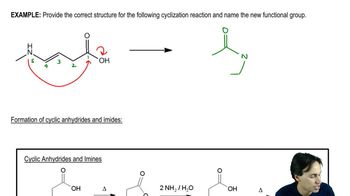
Cyclization Reactions

Cyclization reactions involve the formation of a cyclic compound from a linear precursor. In the case of octane-2,7-dione, the molecule can undergo intramolecular reactions where functional groups react to form a ring structure. Understanding the mechanisms of cyclization, including the role of nucleophiles and electrophiles, is crucial for predicting the formation of cycloheptenone.
추천 영상:
01:33
Cyclization Reaction

Stability of Cyclic Compounds

The stability of cyclic compounds is influenced by factors such as ring strain, torsional strain, and angle strain. Cycloheptenone, being a seven-membered ring, may experience significant strain due to its non-ideal bond angles and steric interactions. This strain can make the formation of cycloheptenone less favorable compared to other possible products or conformations.
추천 영상:
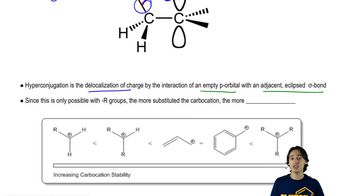
05:58
Determining Carbocation Stability

Thermodynamics of Ring Closure

The thermodynamics of ring closure involves evaluating the energy changes associated with forming a cyclic structure. Factors such as enthalpy and entropy play a critical role in determining whether a cyclization reaction is favorable. In the case of octane-2,7-dione, unfavorable enthalpic contributions from strain and steric hindrance may outweigh any entropic benefits, leading to a disfavoring of cycloheptenone formation.
추천 영상:
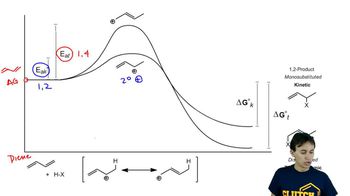
08:51
Kinetic vs. Thermodynamic Control