Ch. 23 - Carbohydrates and Nucleic Acids
Wade - Organic Chemistry 9th Edition
Wade9th EditionOrganic ChemistryISBN: 9780135213728당신이 사용하는 게 아니라요?교과서 변경
23장, 문제 25b

Show what happens when the product of part (a) is hydrolyzed using dilute acid.

검증된 단계별 안내
1
Identify the product from part (a) and determine its functional groups. For example, if the product contains an ester group, hydrolysis will target this functional group.
Understand the mechanism of acid-catalyzed hydrolysis. In this reaction, the ester group reacts with water in the presence of a dilute acid (e.g., HCl or H2SO4) to form a carboxylic acid and an alcohol.
Write the general reaction for acid-catalyzed hydrolysis: ROOR+H2O→ROH+RCOOH, where R represents alkyl or aryl groups.
Propose the specific hydrolysis reaction for the product of part (a). Replace the generic R groups in the general reaction with the actual groups from the product of part (a).
Draw the structures of the resulting products (e.g., the carboxylic acid and alcohol) and ensure that the reaction is balanced. Verify that the hydrolysis mechanism is consistent with the functional groups present in the product of part (a).

비슷한 문제에 대한 검증된 영상 답변:

이 영상 해법은 위 문제에 도움이 된다고 튜터들이 추천한 것입니다.
영상 길이:
5m

주요 개념

질문에 올바르게 답하기 위해 반드시 이해해야 하는 핵심 개념들은 다음과 같습니다.

Hydrolysis

Hydrolysis is a chemical reaction involving the breaking of a bond in a molecule using water. In organic chemistry, it often refers to the reaction of a compound with water or an aqueous solution, leading to the formation of new products. When hydrolyzing an organic compound, such as an ester or an amide, the reaction typically results in the formation of an alcohol and a carboxylic acid or an amine, respectively.
추천 영상:
가이드 코스
1:00
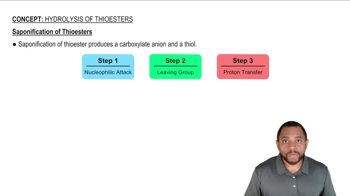
Hydrolysis of Thioesters Concept 2

Dilute Acid

A dilute acid is an acid that has been mixed with a significant amount of water, reducing its concentration. In hydrolysis reactions, dilute acids, such as hydrochloric acid (HCl) or sulfuric acid (H2SO4), are often used as catalysts to facilitate the reaction. The presence of a dilute acid can help to protonate the reactants, making them more reactive and promoting the cleavage of bonds during hydrolysis.
추천 영상:
02:23
Using factors affecting acidity to rank acids

Reaction Mechanism

A reaction mechanism is a step-by-step description of the process by which reactants are converted into products in a chemical reaction. Understanding the mechanism of hydrolysis is crucial, as it involves several stages, including protonation of the substrate, nucleophilic attack by water, and subsequent bond cleavage. This knowledge helps predict the products formed and the conditions required for the reaction to proceed efficiently.
추천 영상:
02:16
Heck Reaction Mechanism