The mechanism of glycoside formation is the same as the second part of the mechanism for acetal formation. Propose a mechanism for the formation of methyl β-D-glucopyranoside.
Ch. 23 - Carbohydrates and Nucleic Acids
23장, 문제 23a
Show the products that result from hydrolysis of amygdalin in dilute acid. Can you suggest why amygdalin might be toxic to tumor (and possibly other) cells?
검증된 단계별 안내1
Step 1: Analyze the structure of amygdalin. Amygdalin is a glycoside composed of two sugar units (glucose) and a cyanogenic aromatic compound (benzyl cyanide group). The glycosidic bond connects the sugar units to the aromatic moiety.
Step 2: Understand the hydrolysis reaction. Hydrolysis in dilute acid involves breaking glycosidic bonds and ester bonds through the addition of water, facilitated by the acidic environment. This reaction will cleave amygdalin into its constituent parts.
Step 3: Predict the products of hydrolysis. The glycosidic bond will break, releasing two molecules of glucose and one molecule of benzaldehyde cyanohydrin (which can further decompose into benzaldehyde and hydrogen cyanide under acidic conditions).
Step 4: Explain the toxicity of amygdalin. The hydrolysis of amygdalin releases hydrogen cyanide (HCN), a potent inhibitor of cytochrome c oxidase in the electron transport chain. This inhibition disrupts cellular respiration, which can be particularly harmful to rapidly dividing cells, such as tumor cells.
Step 5: Summarize the reaction. The hydrolysis of amygdalin in dilute acid yields glucose, benzaldehyde, and hydrogen cyanide. The release of HCN is the primary reason for its potential toxicity to tumor cells and other cells.

비슷한 문제에 대한 검증된 영상 답변:
이 영상 해법은 위 문제에 도움이 된다고 튜터들이 추천한 것입니다.
영상 길이:
1m주요 개념
질문에 올바르게 답하기 위해 반드시 이해해야 하는 핵심 개념들은 다음과 같습니다.
Hydrolysis
Hydrolysis is a chemical reaction involving the breaking of a bond in a molecule using water. In the context of amygdalin, hydrolysis occurs in the presence of dilute acid, leading to the formation of glucose, benzaldehyde, and hydrogen cyanide. Understanding hydrolysis is crucial for predicting the products formed when amygdalin is treated with an acid.
추천 영상:
가이드 코스
Hydrolysis of Thioesters Concept 2
Amygdalin Structure and Function
Amygdalin is a cyanogenic glycoside found in various plants, including almonds and apricots. Its structure consists of a glucose molecule linked to a benzaldehyde and a cyanide group. Recognizing its structure helps in understanding how it can release toxic compounds upon hydrolysis, which is significant in discussing its potential toxicity to cells.
추천 영상:
Identifying Functional Groups
Cyanide Toxicity
Cyanide is a highly toxic compound that can inhibit cellular respiration by blocking the electron transport chain in mitochondria. This mechanism is particularly harmful to rapidly dividing cells, such as tumor cells, which may explain why amygdalin could be toxic to them. Understanding cyanide's effects is essential for evaluating the implications of amygdalin's hydrolysis products.
추천 영상:
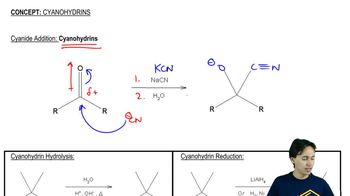
Addition of Cyanide
관련 실천
교과서 질문
1345
views
교과서 질문
Draw the structures of the compound ethyl β-D-ribofuranoside.
Allose is the C3 epimer of glucose, and ribose is the C2 epimer of arabinose.
702
views
교과서 질문
Show what happens when the product of part (a) is hydrolyzed using dilute acid.
746
views
교과서 질문
Predict the products obtained when d-galactose reacts with each reagent.
(a) Br2 and H2O
983
views
교과서 질문
Treatment of either anomer of fructose with excess ethanol in the presence of a trace of HCl gives a mixture of the α and β anomers of ethyl-D-fructofuranoside. Draw the starting materials, reagents, and products for this reaction. Circle the aglycone in each product.
1025
views
교과서 질문
Show the product that results when fructose is treated with an excess of methyl iodide and silver oxide.
1010
views