Ch. 24 - Amino Acids, Peptides, and Proteins
Wade - Organic Chemistry 9th Edition
Wade9th EditionOrganic ChemistryISBN: 9780135213728당신이 사용하는 게 아니라요?교과서 변경
24장, 문제 27a

(a) The isoelectric point (pI) of phenylalanine is pH 5.5. Draw the structure of the major form of phenylalanine at pH values of 1, 5.5, and 11.

검증된 단계별 안내
1
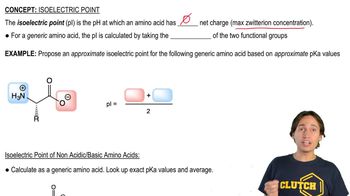
Step 1: Understand the concept of isoelectric point (pI). The isoelectric point is the pH at which a molecule, such as an amino acid, has no net charge. For phenylalanine, the pI is 5.5, meaning it exists as a zwitterion (neutral form) at this pH.
Step 2: Analyze the structure of phenylalanine. Phenylalanine is an amino acid with an amino group (-NH3+), a carboxylic acid group (-COOH), and a phenyl side chain. The protonation state of the amino and carboxylic acid groups changes with pH.
Step 3: Determine the structure of phenylalanine at pH 1. At this low pH, the environment is highly acidic, so both the amino group and the carboxylic acid group will be protonated. The structure will have a positively charged amino group (-NH3+) and a neutral carboxylic acid group (-COOH).
Step 4: Determine the structure of phenylalanine at pH 5.5. At this pH (the isoelectric point), phenylalanine exists as a zwitterion. The amino group will be protonated (-NH3+), and the carboxylic acid group will be deprotonated (-COO−), resulting in no net charge.
Step 5: Determine the structure of phenylalanine at pH 11. At this high pH, the environment is basic, so the amino group will lose a proton and become neutral (-NH2), while the carboxylic acid group remains deprotonated (-COO−). The overall charge of the molecule will be negative.

비슷한 문제에 대한 검증된 영상 답변:

이 영상 해법은 위 문제에 도움이 된다고 튜터들이 추천한 것입니다.
영상 길이:
7m

주요 개념

질문에 올바르게 답하기 위해 반드시 이해해야 하는 핵심 개념들은 다음과 같습니다.

Isoelectric Point (pI)

The isoelectric point (pI) is the pH at which a molecule, such as an amino acid, carries no net electrical charge. For phenylalanine, the pI of 5.5 indicates that at this pH, the positive and negative charges balance out, resulting in a neutral molecule. Understanding pI is crucial for predicting the behavior of amino acids in different pH environments.
추천 영상:
03:19
Definition of Isoelectric Point

Amino Acid Structure

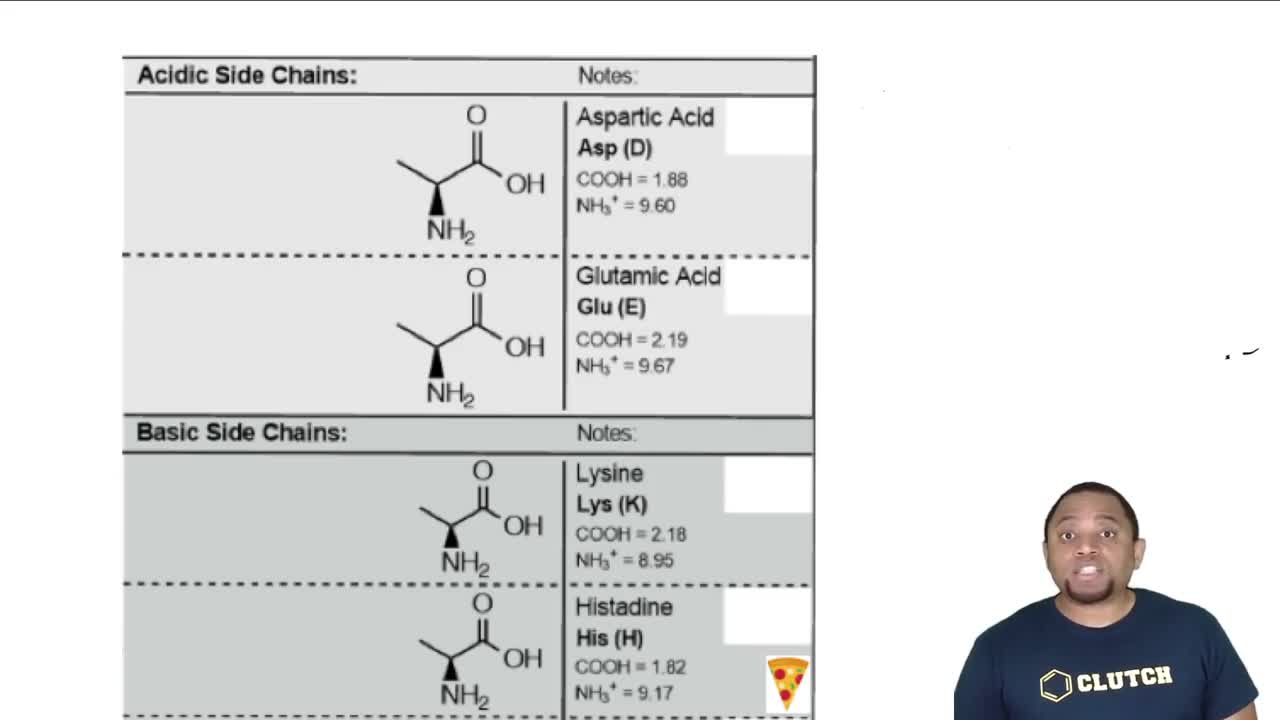
Amino acids have a general structure consisting of a central carbon atom, an amino group (-NH2), a carboxyl group (-COOH), a hydrogen atom, and a variable side chain (R group). For phenylalanine, the side chain is a benzyl group, which influences its properties and behavior in solution. Recognizing how these groups interact with pH is essential for drawing the correct structures at different pH levels.
추천 영상:
7:19
Charged Amino Acids

Protonation and Deprotonation

Protonation and deprotonation refer to the addition or removal of protons (H+) from a molecule, affecting its charge and structure. At low pH (1), amino acids are typically protonated, leading to a positively charged form. At high pH (11), they are deprotonated, resulting in a negatively charged form. Understanding these processes is vital for determining the predominant form of phenylalanine at various pH levels.
추천 영상:
03:
Proton Splitting