
Ch.3 - Structure and Stereochemistry of Alkanes
Wade - Organic Chemistry 9th Edition
Wade9th EditionOrganic ChemistryISBN: 9780135213728당신이 사용하는 게 아니라요?교과서 변경
3장, 문제 40c

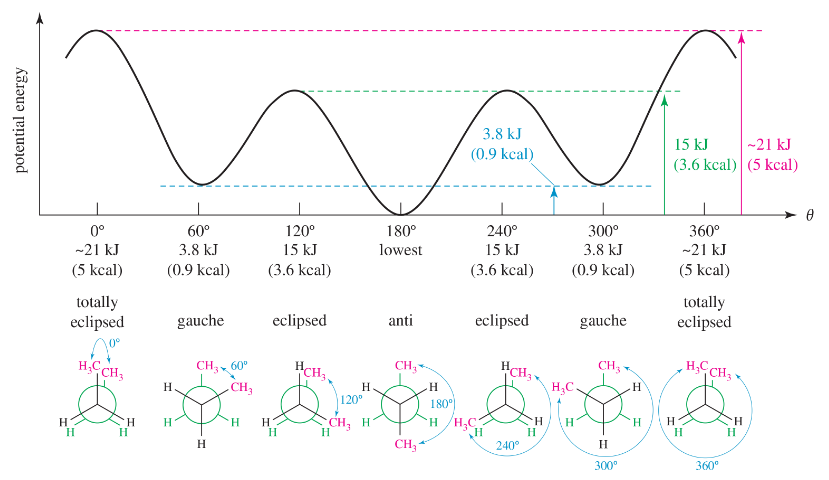
Construct a graph, similar to Figure 3-11, of the torsional energy of 3-methylpentane along the C2―C3 bond.
c. Begin your graph at the 0° dihedral angle and begin to turn the front carbon.

검증된 단계별 안내
1
Step 1: Understand the problem. You are tasked with constructing a graph of the torsional energy of 3-methylpentane along the C2-C3 bond as the front carbon rotates. This involves analyzing the energy contributions of different conformations (eclipsed, gauche, anti) and plotting them against the dihedral angle (0° to 360°).
Step 2: Identify the key interactions. For 3-methylpentane, the substituents on the C2 and C3 carbons include hydrogen atoms, methyl groups, and ethyl groups. Use the provided energy contribution table to determine the torsional strain for each conformation (eclipsed and gauche).
Step 3: Calculate the torsional energy for each dihedral angle. At 0° (totally eclipsed), the largest substituents (CH3 groups) are aligned, resulting in the highest energy. At 60° (gauche), the CH3 groups are staggered but still close, contributing a lower energy. At 180° (anti), the CH3 groups are furthest apart, resulting in the lowest energy. Repeat this process for all angles (0°, 60°, 120°, 180°, 240°, 300°, 360°).
Step 4: Plot the energy values against the dihedral angle. Use the calculated torsional energy values to create a graph similar to Figure 3-11. The x-axis represents the dihedral angle (0° to 360°), and the y-axis represents the torsional energy. Ensure the graph reflects the periodic nature of the energy changes as the molecule rotates.
Step 5: Label the graph. Clearly mark the conformations (eclipsed, gauche, anti) at their respective dihedral angles. Indicate the energy values for each conformation and highlight the key points, such as the highest energy (totally eclipsed) and lowest energy (anti).

비슷한 문제에 대한 검증된 영상 답변:

이 영상 해법은 위 문제에 도움이 된다고 튜터들이 추천한 것입니다.
영상 길이:
8m

주요 개념

질문에 올바르게 답하기 위해 반드시 이해해야 하는 핵심 개념들은 다음과 같습니다.

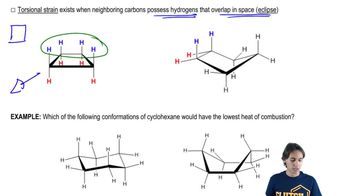
Torsional Strain

Torsional strain arises from the repulsion between electron clouds in eclipsed conformations of a molecule. In the case of 3-methylpentane, as the dihedral angle between the C2 and C3 bonds changes, the molecule experiences varying levels of torsional strain, which affects its potential energy. Understanding this concept is crucial for analyzing the energy graph and predicting the stability of different conformations.
추천 영상:
02:00
What is torsional strain?

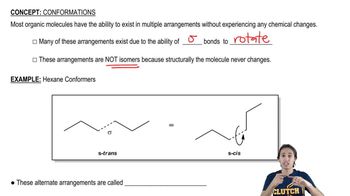
Conformational Analysis

Conformational analysis involves studying the different spatial arrangements of atoms in a molecule and how these arrangements influence its energy and stability. For 3-methylpentane, the analysis focuses on the various conformations (e.g., staggered, eclipsed) around the C2-C3 bond. This concept helps in constructing the energy graph by identifying the energy minima and maxima corresponding to different dihedral angles.
추천 영상:
03:29
Understanding what a conformer is.

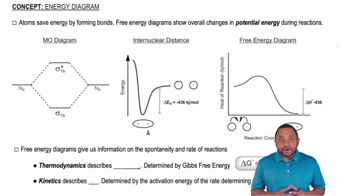
Potential Energy Diagram

A potential energy diagram visually represents the energy changes of a molecule as it undergoes conformational changes. In the context of 3-methylpentane, the graph illustrates how the potential energy varies with the dihedral angle between the C2 and C3 bonds, highlighting the energy barriers associated with eclipsed and staggered conformations. This diagram is essential for understanding the stability of different molecular arrangements.
추천 영상:
08:30
Introduction to free energy diagrams.