Ch.8 - Reactions of Alkenes
Wade - Organic Chemistry 9th Edition
Wade9th EditionOrganic ChemistryISBN: 9780135213728당신이 사용하는 게 아니라요?교과서 변경
8장, 문제 27c

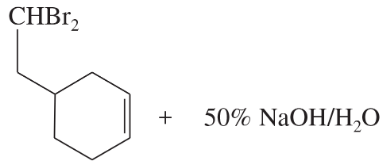
Predict the carbenoid addition products of the following reactions.
(c)

검증된 단계별 안내
1
Step 1: Recognize that the reaction involves a dibromocarbene (:CBr2) formation. The presence of 50% NaOH and water indicates a basic medium, which facilitates the generation of the carbenoid intermediate from the CHBr2 group.
Step 2: In the basic medium, the hydroxide ion (OH⁻) deprotonates the CHBr2 group, leading to the formation of a bromoform intermediate (CHBr3). This intermediate then loses a bromide ion (Br⁻) to generate the carbenoid species (:CBr2).
Step 3: The carbenoid (:CBr2) reacts with the double bond in the cyclohexene ring via a cyclopropanation reaction. This reaction forms a three-membered cyclopropane ring fused to the cyclohexane ring, with two bromine atoms attached to the newly formed cyclopropane ring.
Step 4: Draw the product structure. The product will be a bicyclic compound where the cyclohexene ring is fused to a cyclopropane ring, and the two bromine atoms are attached to the cyclopropane ring.
Step 5: Verify the stereochemistry of the product. Since the reaction occurs via a concerted mechanism, the stereochemistry of the substituents on the double bond in the starting material will be preserved in the product.

비슷한 문제에 대한 검증된 영상 답변:

이 영상 해법은 위 문제에 도움이 된다고 튜터들이 추천한 것입니다.
영상 길이:
7m

주요 개념

질문에 올바르게 답하기 위해 반드시 이해해야 하는 핵심 개념들은 다음과 같습니다.

Carbenoids

Carbenoids are reactive intermediates that resemble carbenes but are more stable and can be generated from certain precursors, such as halogenated compounds. They participate in various organic reactions, including cyclopropanation and addition reactions, where they can add across double bonds or react with nucleophiles. Understanding carbenoids is crucial for predicting the products of reactions involving halogenated compounds.
추천 영상:
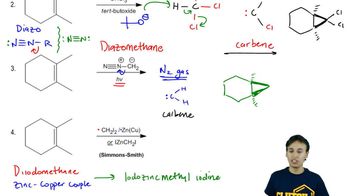
03:13
The Simmons-Smith reaction.

Nucleophilic Substitution Reactions

Nucleophilic substitution reactions involve the replacement of a leaving group in a molecule by a nucleophile. In the context of the given reaction, the hydroxide ion (from NaOH) acts as a nucleophile, attacking the electrophilic carbon attached to the bromine atoms. This concept is essential for understanding how the reaction proceeds and the types of products formed.
추천 영상:
01:47
Nucleophiles and Electrophiles can react in Substitution Reactions.

Regioselectivity

Regioselectivity refers to the preference of a chemical reaction to occur at one location over another in a molecule. In the case of the reaction shown, the regioselectivity will determine which carbon atom in the double bond is attacked by the carbenoid or nucleophile. Recognizing regioselectivity is vital for predicting the major products of the reaction and understanding the underlying mechanisms.
추천 영상:
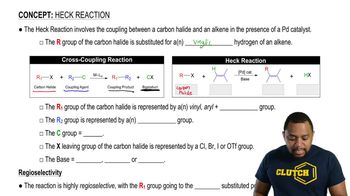
05:09
Heck Reaction