Ch.8 - Reactions of Alkenes
Wade - Organic Chemistry 9th Edition
Wade9th EditionOrganic ChemistryISBN: 9780135213728당신이 사용하는 게 아니라요?교과서 변경
8장, 문제 28b

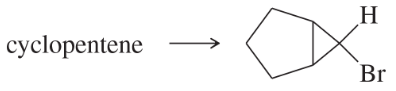
Show how you would accomplish each of the following synthetic conversions.
(b)

검증된 단계별 안내
1
Step 1: Begin with cyclopentene, which contains a double bond. The goal is to convert this into a bicyclic structure with a chlorine atom attached.
Step 2: Perform a halogenation reaction using chlorine gas (Cl₂) in the presence of UV light or heat. This will add a chlorine atom to the allylic position of cyclopentene, forming allyl chloride.
Step 3: Use a Diels-Alder reaction to form the bicyclic structure. React the allyl chloride with a suitable dienophile, such as maleic anhydride, under heat to form the bicyclic intermediate.
Step 4: Perform a selective elimination or rearrangement reaction to remove any unwanted substituents and ensure the chlorine atom is positioned correctly on the bicyclic structure.
Step 5: Purify the final product using techniques such as distillation or recrystallization to isolate the desired bicyclic compound with the chlorine atom attached.

비슷한 문제에 대한 검증된 영상 답변:

이 영상 해법은 위 문제에 도움이 된다고 튜터들이 추천한 것입니다.
영상 길이:
10m

주요 개념

질문에 올바르게 답하기 위해 반드시 이해해야 하는 핵심 개념들은 다음과 같습니다.

Electrophilic Addition Reactions

Electrophilic addition reactions are a fundamental type of reaction in organic chemistry where an electrophile reacts with a nucleophile, resulting in the addition of atoms or groups across a double bond. In the case of cyclopentene, the double bond acts as a nucleophile, allowing for the addition of electrophiles such as halogens. This process is crucial for converting alkenes into more complex structures, such as chlorinated products.
추천 영상:
05:39
Features of Addition Mechanisms.

Regioselectivity

Regioselectivity refers to the preference of a chemical reaction to yield one structural isomer over others when multiple possibilities exist. In the chlorination of cyclopentene, the regioselectivity will determine which carbon atom in the double bond will bond with the chlorine atom. Understanding regioselectivity is essential for predicting the outcome of synthetic conversions and ensuring the desired product is formed.
추천 영상:
05:09
Heck Reaction

Mechanism of Halogenation

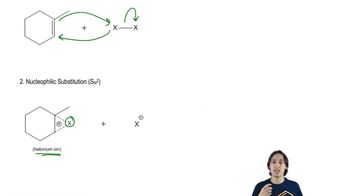
The mechanism of halogenation involves the formation of a cyclic halonium ion intermediate when a halogen (like Cl2) adds to an alkene. This intermediate is crucial as it influences the stereochemistry and regioselectivity of the final product. Recognizing this mechanism helps in understanding how cyclopentene can be transformed into a chlorinated product, as it outlines the steps and intermediates involved in the reaction.
추천 영상:
03:45
Halogenation Mechanism