Ch.8 - Reactions of Alkenes
Wade - Organic Chemistry 9th Edition
Wade9th EditionOrganic ChemistryISBN: 9780135213728당신이 사용하는 게 아니라요?교과서 변경
8장, 문제 46d

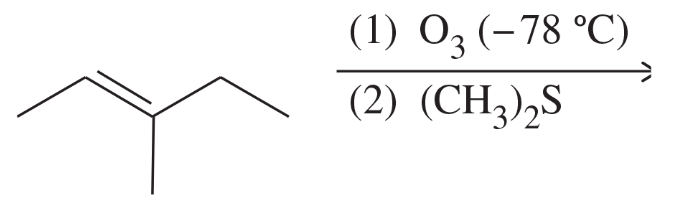
Predict the major products of the following reactions, and give the structures of any intermediates. Include stereochemistry where appropriate.
(d)

검증된 단계별 안내
1
Step 1: Recognize the reaction type. This is an ozonolysis reaction, which involves the cleavage of alkenes using ozone (O₃) followed by a reductive workup with dimethyl sulfide ((CH₃)₂S). The goal is to break the double bond and form carbonyl compounds.
Step 2: Analyze the structure of the starting alkene. The given molecule is a substituted alkene with a double bond between two carbon atoms. Identify the two carbons involved in the double bond and their substituents.
Step 3: Predict the intermediate formed after the reaction with ozone. Ozone reacts with the double bond to form an unstable intermediate called a molozonide, which rearranges to form an ozonide. This intermediate is not isolated but is important to understand the mechanism.
Step 4: Determine the products formed after reductive workup. The ozonide is cleaved by dimethyl sulfide ((CH₃)₂S), resulting in the formation of two carbonyl compounds. Each carbon of the original double bond becomes part of a carbonyl group (either an aldehyde or a ketone).
Step 5: Include stereochemistry if applicable. In this case, stereochemistry is not relevant because the reaction breaks the double bond and forms planar carbonyl compounds. Draw the structures of the final products, ensuring the substituents on the original alkene are correctly placed on the carbonyl compounds.

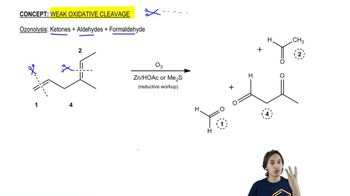
비슷한 문제에 대한 검증된 영상 답변:

이 영상 해법은 위 문제에 도움이 된다고 튜터들이 추천한 것입니다.
영상 길이:
2m

주요 개념

질문에 올바르게 답하기 위해 반드시 이해해야 하는 핵심 개념들은 다음과 같습니다.

Ozonolysis

Ozonolysis is a reaction involving the cleavage of alkenes or alkynes using ozone (O3) to form carbonyl compounds. The reaction typically occurs in two steps: first, ozone adds to the double or triple bond to form a molozonide, which rearranges to a more stable ozonide. The ozonide is then reduced, often using a reagent like dimethyl sulfide ((CH3)2S), to yield aldehydes or ketones as the final products.
추천 영상:
06:30
General properties of ozonolysis.

Stereochemistry

Stereochemistry refers to the study of the spatial arrangement of atoms in molecules and how this affects their chemical behavior. In reactions like ozonolysis, the stereochemistry of the starting material can influence the configuration of the products. Understanding stereochemistry is crucial for predicting the correct structures of intermediates and final products, especially when chiral centers are involved.
추천 영상:
가이드 코스
1:38
Polymer Stereochemistry Concept 1

Reaction Mechanism

A reaction mechanism is a step-by-step description of the process by which reactants are converted into products. In ozonolysis, the mechanism includes the formation of the molozonide, its rearrangement to the ozonide, and subsequent reduction. Analyzing the mechanism helps in predicting the major products and intermediates, as well as understanding the role of reagents and conditions in the reaction.
추천 영상:
02:16
Heck Reaction Mechanism