Ch.8 - Reactions of Alkenes
Wade - Organic Chemistry 9th Edition
Wade9th EditionOrganic ChemistryISBN: 9780135213728당신이 사용하는 게 아니라요?교과서 변경
8장, 문제 46b

Predict the major products of the following reactions, and give the structures of any intermediates. Include stereochemistry where appropriate.
(b)

검증된 단계별 안내
1
Step 1: Recognize the type of reaction. The reaction involves bromine (Br₂) in a non-polar solvent (CCl₄), which indicates a halogenation reaction of an alkene. This reaction proceeds via an electrophilic addition mechanism.
Step 2: Identify the alkene in the structure. The double bond in the cyclopentene structure is the reactive site where bromine will add.
Step 3: Describe the mechanism. Bromine (Br₂) approaches the double bond, and the π-electrons of the alkene attack the bromine molecule, forming a bromonium ion intermediate. This intermediate is a three-membered ring structure with a positive charge on the bromine.
Step 4: Explain the nucleophilic attack. The bromide ion (Br⁻), generated during the dissociation of Br₂, attacks the bromonium ion from the opposite side (anti-addition), leading to the formation of a vicinal dibromide.
Step 5: Include stereochemistry. Since the addition of bromine occurs via anti-addition, the two bromine atoms will be added to opposite faces of the cyclopentene ring, resulting in a trans-dibromide product.

비슷한 문제에 대한 검증된 영상 답변:

이 영상 해법은 위 문제에 도움이 된다고 튜터들이 추천한 것입니다.
영상 길이:
9m

주요 개념

질문에 올바르게 답하기 위해 반드시 이해해야 하는 핵심 개념들은 다음과 같습니다.

Electrophilic Addition Reactions

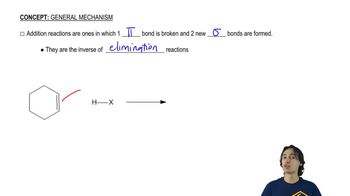
Electrophilic addition reactions involve the addition of an electrophile to a nucleophile, typically across a double bond. In this case, bromine (Br2) acts as the electrophile, adding across the double bond of the cyclohexene. Understanding this mechanism is crucial for predicting the products formed during the reaction.
추천 영상:
05:39
Features of Addition Mechanisms.

Stereochemistry

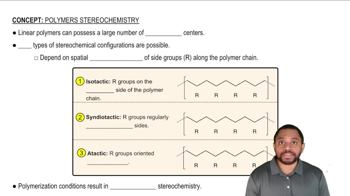
Stereochemistry refers to the spatial arrangement of atoms in molecules and how this affects their chemical behavior. In the context of the reaction shown, the addition of bromine can lead to different stereoisomers, such as enantiomers or diastereomers, depending on the orientation of the bromine atoms added to the double bond. Recognizing stereochemical outcomes is essential for accurately depicting the products.
추천 영상:
가이드 코스
1:38
Polymer Stereochemistry Concept 1

Reaction Intermediates

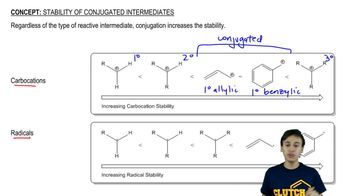
Reaction intermediates are transient species formed during the conversion of reactants to products. In the case of bromine addition to cyclohexene, a cyclic bromonium ion may form as an intermediate. Identifying these intermediates helps in understanding the reaction pathway and predicting the final products, including their stereochemistry.
추천 영상:
04:31
Stability of Conjugated Intermediates