Ch.9 - Alkynes
Wade - Organic Chemistry 9th Edition
Wade9th EditionOrganic ChemistryISBN: 9780135213728당신이 사용하는 게 아니라요?교과서 변경
9장, 문제 14

In the addition of just 1 mole of bromine to 1 mole of hex-1-yne, should the hex-1-yne be added to a bromine solution or should the bromine be added to the hex-1-yne? Explain your answer.

검증된 단계별 안내
1
Step 1: Understand the reaction mechanism. The addition of bromine (Br₂) to hex-1-yne is an electrophilic addition reaction. Hex-1-yne, being an alkyne, has a high electron density in its triple bond, making it nucleophilic and capable of attacking the electrophilic bromine molecule.
Step 2: Recognize the reactivity of bromine. Bromine (Br₂) is a diatomic molecule that can act as an electrophile when its bond is polarized. This polarization occurs when bromine approaches the electron-rich triple bond of hex-1-yne.
Step 3: Consider the practical aspect of the reaction. To ensure a controlled and efficient reaction, the bromine solution should be added dropwise to the hex-1-yne. This approach minimizes the risk of overreaction or side reactions, as bromine is highly reactive and can lead to the addition of more than one mole if not carefully controlled.
Step 4: Explain the reasoning. Adding bromine to hex-1-yne allows for better control of the reaction stoichiometry, ensuring that only 1 mole of bromine reacts with 1 mole of hex-1-yne. If hex-1-yne were added to a bromine solution, the excess bromine could lead to further addition reactions, forming a tetrabromo product instead of the desired dibromo product.
Step 5: Conclude the explanation. Therefore, to achieve the desired product (a dibromoalkene), bromine should be added to hex-1-yne in a controlled manner, typically dropwise, to ensure the reaction proceeds as intended.

비슷한 문제에 대한 검증된 영상 답변:

이 영상 해법은 위 문제에 도움이 된다고 튜터들이 추천한 것입니다.
영상 길이:
8m

주요 개념

질문에 올바르게 답하기 위해 반드시 이해해야 하는 핵심 개념들은 다음과 같습니다.

Electrophilic Addition

Electrophilic addition is a fundamental reaction mechanism in organic chemistry where an electrophile reacts with a nucleophile, resulting in the formation of a more saturated compound. In the case of alkynes like hex-1-yne, the triple bond acts as a nucleophile, attacking the electrophilic bromine molecule. Understanding this mechanism is crucial for predicting the outcome of the reaction.
추천 영상:
09:23
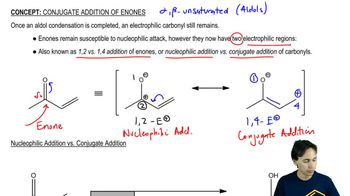
1,2 vs 1,4 Addition

Reactivity of Alkynes

Alkynes, characterized by their carbon-carbon triple bonds, are more reactive than alkenes due to the high electron density of the triple bond. This reactivity allows them to undergo addition reactions readily. Knowing the reactivity of hex-1-yne helps in determining the order of addition in the bromination process.
추천 영상:
09:11
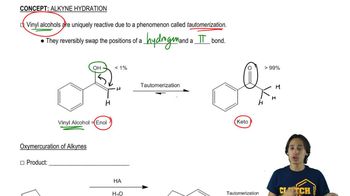
Alkyne Hydration

Solubility and Reaction Medium

The solubility of reactants in the reaction medium can significantly influence the reaction pathway and rate. Bromine is typically added to a solution, and the choice of whether to add hex-1-yne to bromine or vice versa can affect the distribution of products. Understanding the solubility of both bromine and hex-1-yne in the chosen solvent is essential for optimizing the reaction conditions.
추천 영상:
02:01
Introducing common solvents and other molecules in organic chemistry.