Propose a mechanism for the entire reaction of pent-1-yne with 2 moles of HBr. Show why Markovnikov's rule should be observed in both the first and second additions of HBr.
Ch.9 - Alkynes
9장, 문제 16a,b
Predict the major product(s) of the following reactions:
a. phenylacetylene + 2 HBr
b. hex-1-yne + 2 HCl
검증된 단계별 안내1
Step 1: Recognize the type of reaction. Both reactions involve the addition of hydrogen halides (HBr and HCl) to alkynes. This is an electrophilic addition reaction where the π-bond of the alkyne reacts with the hydrogen halide.
Step 2: Understand the regioselectivity. In the presence of excess hydrogen halide, the reaction follows Markovnikov's rule. This means the hydrogen atom from the hydrogen halide will add to the carbon of the triple bond that already has more hydrogens, while the halide (Br⁻ or Cl⁻) will add to the carbon with fewer hydrogens.
Step 3: For part (a), phenylacetylene + 2HBr: The first equivalent of HBr adds to the triple bond, forming a vinyl bromide intermediate. The second equivalent of HBr adds to the double bond of the intermediate, resulting in a geminal dibromide (both bromine atoms attached to the same carbon).
Step 4: For part (b), hex-1-yne + 2HCl: The first equivalent of HCl adds to the triple bond, forming a vinyl chloride intermediate. The second equivalent of HCl adds to the double bond of the intermediate, resulting in a geminal dichloride (both chlorine atoms attached to the same carbon).
Step 5: Verify the products. In both cases, the major product is a geminal dihalide due to the Markovnikov addition of the hydrogen halides. Ensure the structures of the products are consistent with the regioselectivity and the reaction mechanism.

비슷한 문제에 대한 검증된 영상 답변:
이 영상 해법은 위 문제에 도움이 된다고 튜터들이 추천한 것입니다.
영상 길이:
7m주요 개념
질문에 올바르게 답하기 위해 반드시 이해해야 하는 핵심 개념들은 다음과 같습니다.
Alkyne Reactivity
Alkynes are hydrocarbons containing a carbon-carbon triple bond, which makes them highly reactive. They can undergo addition reactions where reagents add across the triple bond. In the presence of hydrogen halides like HBr or HCl, alkynes can react to form haloalkenes or haloalkanes, depending on the number of equivalents of the halide used.
추천 영상:
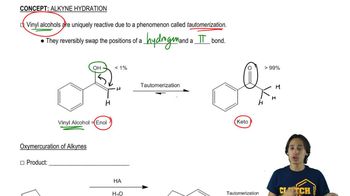
Alkyne Hydration
Markovnikov's Rule
Markovnikov's Rule states that in the addition of HX to an alkene or alkyne, the hydrogen atom will attach to the carbon with the greater number of hydrogen atoms already attached. This rule helps predict the major product of reactions involving unsymmetrical reagents, guiding the formation of more stable carbocation intermediates during the reaction.
추천 영상:
The 18 and 16 Electron Rule
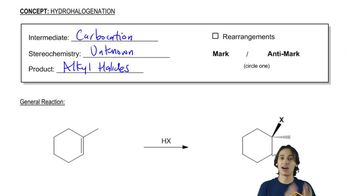
Hydrohalogenation
Hydrohalogenation is a chemical reaction where hydrogen halides (like HBr or HCl) add to alkenes or alkynes. In the case of terminal alkynes, this reaction can occur in a two-step process, where the first addition forms a vinyl halide, and a second addition can lead to a geminal dihalide. Understanding this process is crucial for predicting the products of the given reactions.
추천 영상:
General properties of hydrohalogenation.
관련 실천
교과서 질문
1345
views
교과서 질문
The fragrance of (Z)-1-phenylhex-2-en-1-ol resembles that of roses, with a delicate citrus edge. Show how you would synthesize this compound from benzaldehyde (PhCHO) and any other reagents you need.
1078
views
교과서 질문
In the addition of just 1 mole of bromine to 1 mole of hex-1-yne, should the hex-1-yne be added to a bromine solution or should the bromine be added to the hex-1-yne? Explain your answer.
1236
views
교과서 질문
Show how hex-1-yne might be converted to
a. 1,2-dichlorohex-1-ene.
b. 1-bromohex-1-ene.
c. 2-bromohex-1-ene.
1056
views
교과서 질문
Propose a mechanism for the reaction of pent-1-yne with HBr in the presence of peroxides. Show why anti-Markovnikov orientation results.
1340
views
교과서 질문
Predict the major product(s) of the following reactions:
c. cyclooctyne + 2 HBr
d. *hex-2-yne + 2 HCl
1173
views