Ch.6 - Alkyl Halides; Nucleophilic Substitution
Wade - Organic Chemistry 9th Edition
Wade9th EditionOrganic ChemistryISBN: 9780135213728당신이 사용하는 게 아니라요?교과서 변경
6장, 문제 13b

Consider the reaction of 1-bromobutane with a large excess of ammonia (NH3). Draw the reactants, the transition state, and the products. Note that the initial product is the salt of an amine (RNH3+Br−), which is deprotonated by the excess ammonia to give the amine.

검증된 단계별 안내
1
Step 1: Identify the type of reaction. This is a nucleophilic substitution reaction (SN2 mechanism) where ammonia (NH3) acts as the nucleophile and 1-bromobutane (CH3CH2CH2CH2Br) is the substrate. The bromine atom is the leaving group.
Step 2: Draw the reactants. Represent 1-bromobutane as CH3CH2CH2CH2Br and ammonia as NH3. Show the lone pair of electrons on the nitrogen atom in NH3, which will attack the carbon atom bonded to the bromine.
Step 3: Illustrate the transition state. In the SN2 mechanism, the nucleophile (NH3) attacks the electrophilic carbon atom from the opposite side of the leaving group (Br−). Draw a pentavalent carbon in the transition state with partial bonds to both the nucleophile (NH3) and the leaving group (Br−). Use dashed lines to represent these partial bonds.
Step 4: Draw the initial product. After the bromine leaves, the nitrogen from NH3 is bonded to the carbon chain, forming CH3CH2CH2CH2NH3+. This is the ammonium salt (RNH3+ Br−), where R = CH3CH2CH2CH2.
Step 5: Show the deprotonation step. The excess ammonia (NH3) acts as a base and removes a proton (H+) from CH3CH2CH2CH2NH3+, resulting in the formation of the neutral amine (CH3CH2CH2CH2NH2) and ammonium bromide (NH4+ Br−).

비슷한 문제에 대한 검증된 영상 답변:

이 영상 해법은 위 문제에 도움이 된다고 튜터들이 추천한 것입니다.
영상 길이:
10m

주요 개념

질문에 올바르게 답하기 위해 반드시 이해해야 하는 핵심 개념들은 다음과 같습니다.

Nucleophilic Substitution

Nucleophilic substitution is a fundamental reaction in organic chemistry where a nucleophile attacks an electrophile, resulting in the replacement of a leaving group. In the case of 1-bromobutane reacting with ammonia, the ammonia acts as a nucleophile, attacking the carbon atom bonded to the bromine, leading to the formation of an amine.
추천 영상:
01:47
Nucleophiles and Electrophiles can react in Substitution Reactions.

Transition State

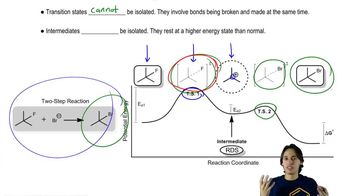
The transition state is a high-energy, unstable arrangement of atoms that occurs during a chemical reaction. It represents the point at which reactants are transformed into products. In this reaction, the transition state would involve the partial bond formation between the nitrogen of ammonia and the carbon of 1-bromobutane, as well as the partial bond breaking of the C-Br bond.
추천 영상:
06:55
Intermediates vs. Transition States

Deprotonation

Deprotonation is the removal of a proton (H+) from a molecule, resulting in the formation of a base. In this reaction, after the initial product (RNH3+ Br−) is formed, the excess ammonia deprotonates the ammonium salt to yield the neutral amine. This step is crucial for obtaining the final product and illustrates the role of ammonia as both a nucleophile and a base.
추천 영상:
가이드 코스
4:30
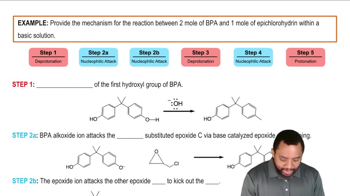
Step-Growth Polymers: Epoxy Resin Example 1